Showing posts with label 2HN. Show all posts

Friday, May 30, 2014

NBA Jam: 2HN Basketball Buffoonery

During my UCLA days in the early to mid-1990s, the video game console wars were in full effect with Sega and Nintendo jockeying for the top spot in the marketplace, specifically the media war between the Sega Genesis and the Super Nintendo. At the time, people either owned one or the other and rarely owned both, as if either company loyalty was that important or consoles and games were just too expensive to invest in two separate systems. As consoles became closer to arcade quality in their presentation of graphics and sound, video game cabinet manufacturers seemed to up the ante, having already introduced laserdisc-based games like Dragon's Lair and Firefox (based on the Clint Eastwood movie) and rolling out games with superior graphics, sound, and two-player gameplay like the once-ubiquitous Street Fighter II, Mortal Kombat, and NBA Jam. Initially, Sega and Nintendo, though capable of (then) superlative home-based video games, struggled to convert arcade-based games like Street Fighter II and NBA Jam to their consoles... but they eventually succeeded with differing results. While Nintendo (and, to some extent, Sega) did well to port Street Fighter II to the Super Nintendo, NBA Jam was not nearly the game it was in the arcade.

For anyone who wasn't born before 1990, let me introduce you to the concept of NBA Jam: it's essentially two-on-two basketball with 1990s NBA basketball stars. Do you like the Lakers? Well, you can play with James Worthy and Vlade Divac. Do you like the Golden State Warriors and long for the days of Run-TMC (Tim Hardaway, Mitch Richmond, and Chris Mullin)? Cool, because you could play with Hardaway and Mullin. Oh, you say that you love the Bulls? Of course, you can play with Michael Jordan and Scottie Pippen... or NOT! Instead, you got Pippen and Horace Grant. How about Orlando Magic? Okay, you got Shaquille O'Neal, but you only got Penny Hardaway depending on which console you played the game. Much of who appeared in NBA Jam was dependent on licensing issues and the issues individual players had with royalties and such monetary concerns.

When it came to gameplay, it didn't matter with whom one played because NBA Jam was all about two things: thunderous dunks and fiery three-pointers. The fun of this game was in its uncomplicated, yet undeniably cheesy gameplay which often went like this: with one of your players (it really didn't matter who), you dribble the ball up the floor and either pass to your other player and dunk with heart-pumping authority or you loft a three-pointer from "way downtown." The first dunk of a streak of dunks was rather perfunctory, but the more a particular player dunked, the more acrobatic and gravity-defying the animations became. Likewise, the more a player drained three-pointers, the more the ball would burst into flame and the console or arcade cabinet's speakers would declare that he was "ON FIRE!" or "En fuego!"

The graphics of NBA Jam in the arcade were bright, garish, and eye-popping with each player looking like bobbleheads that are handed out at baseball stadiums as promotional items. Besides that, the uniforms of the players were shadowy reflections of the real-life uniforms, though the home floor of each team was emblazoned with that team's logos and colors to remind us that this WAS the NBA. What was even more indelible in my memory, however, was the sounds of the game: the crowd cheering, the realistic screech of sneakers on hardwood, and the play-by-play announcers' exclamatory remarks all created a hyper-realistic feel that went beyond anything one would watch during an NBA game on television.

In the 1990s, NBA Jam was ever-present in arcades on UCLA's campus and in local arcades and amusement centers I used to visit. I may have played the arcade version of the game once or twice on a lark, but I don't remember doing so. Yet, I'll always recall the NBA Jam announcer blurting, "Rony Seikaly... for three... He's on fire!" even though Rony Seikaly was not known for his three-point shooting. People used to line up their quarters to challenge the reigning player in the arcade; those battles were certainly fun to watch, at least for a few minutes. I never really developed an interest in NBA Jam, but I appreciated its presence in the arcades, at least because the game only added to the animated, noisy buffoonery that was, and still is, inherent to the video arcade lifestyle and motif.

Just last weekend, my wife and I happened upon a garage sale in one of the older homes in our area. Being a semi-avid video game cartridge collector, I reasoned (and hoped) that this older home would have a treasure trove of older games and consoles because the older homes were where peoples lived long enough to accumulate junk from the 1990s and before. Sure enough, I rummaged through a box of discarded and dusty game consoles to find a filthy Super Nintendo console and two cartridges: NBA Jam and Super Mario World 2 (about which I will write later). Both cartridges set me back a few bucks, which I handed to the homeowner with a thin veneer of calm hiding the unrepentant joy and enthusiasm that welled up from within me. Those cartridges were an uncommon find, especially now when savvy sellers are well-aware of the value of retro game cartridges on eBay. I gleefully took both cartridges home, gingerly yet aggressively cleaned the copper pins with Windex and Q-Tips, and washed the outsides of both cartridges with some Greased Lightning and a microfiber cloth. Thankfully, I got both cartridges working in my trusty Retro Duo.

I discovered two things that day: one was that Super Mario World 2 was as awesome as what I had read in a couple of reviews; the other was the NBA Jam on the Super Nintendo was a poor imitation of the arcade version. I played NBA Jam on the SNES for a few minutes to "test" the game's functions and playability and, sadly, found it dull compared to EA Sports' NBA Live series of games. It was just pass-pass-dunk, pass-pass-three, pass-pass-have ball stolen-watch as the computer dunks on my flailing sprites. Oh well... At least the cartridge was cheap and buying it triggered enough of those nostalgic feelings about the arcades of my youth to offset how mediocre NBA  Jam for the SNES was, and still is.

Friday, June 24, 2011

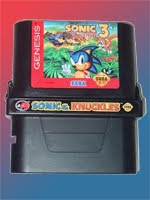
Sonic & Knuckles: 2HN Lock-On Charmer (but a little cheesy)


Back in the early to mid-90s when I was at the height of my Genesis playing days, I used to frequent such stores as Electronics Boutique, waiting for the EA Sports release for NBA Live, NHL, or Madden. Whenever I caught wind of the release of one of these gems, I would take the Blue Bus down to Westside Pavilion and scoop up a copy. It was rather infrequent that I would work up the same enthusiasm for a non-sports game, and I often avoided such games because, at the time, I wasn't interested in anything but sports. For this reason, I often passed up on games that are now considered Sega
Genesis classics, like Earthworm Jim, Rocket Knight Adventures, and the various Sonic titles, about some of which I have blogged. One particular title, which featured a rather innovative design and concept, was Sonic & Knuckles.

When I think back to the 90s, I vaguely recall hearing or reading about the Lock-On technology of Sonic & Knuckles back then. Basically, Sonic & Knuckles is a standalone side-scrolling platformer that is Sonic's modus operandi; anyone familiar with the franchise (at least, in its earlier years) would feel right at home in this game. However, what makes Sonic & Knuckles truly special is its "Lock-On" design, which allows players to plug either Sonic 2 or Sonic 3 into a slot on the Sonic & Knuckles cartridge. If you plug Sonic 2 into Sonic & Knuckles, you can play Sonic 2 as Knuckles; if you plug in Sonic 3, you can play a combined game of Sonic 3 AND Sonic and Knuckles either as Sonic (with Tails) or Knuckles.

As always, you can play as Sonic, spin-dashing through bad guys, looping up and down paths, collecting rings, and jumping here and here; but, you can also play as Knuckles, a red echidna who can't run as fast as, or jump as high as, Sonic does, but can glide and climb walls with his spiky knuckles (thus, the name). Much of the game is familiar with colorful sprites, catchy beats, and vivid backgrounds, but there are new obstacles, such as green chains that latch onto Sonic or Knuckles and can only be escaped by spin-dashing, and new ways of traversing gaps and tricky spots, such as gymnastics-like metal poles and swinging ropes with bars (which are actually similar to what is in Sonic 2).

Sonic & Knuckles has much of what I've come to appreciate about the Sonic franchise on the Genesis: speedy runs, somewhat reasonably precise jumps, and bright and colorful graphics. Despite these positives, this game, as a standalone, is not without its flaws. One is the music: this is personal taste, but I find the music dissonant and irritating compared to Sonic 2. Maybe, it is because my sons have been playing Sonic & Knuckles lately and have been playing the Mushroom Zone over and over again, so the music has worn out its novelty. Another is the length of each zone: some zones take five to six minutes of game time versus the two to four minutes per zone in Sonic 2. For me, longer zones don't make for a more engaging gaming experience. Yet, the biggest irritation of Sonic & Knuckles is (using a term often employed for describing fighting games) its hit detection. As far as I understand it, if you spin and jump on or at a baddie, the baddie transforms into a harmless forest creature and is defeated, but there have been numerous occasions when I have attacked a baddie in this way and lost all my rings. I suppose that it would be safest to jump on top of the baddie, but I have found that hits are not consistently registered. This makes for some frustration end-of-the-zone battles during which I will spin jump level to the boss, but cough up my rings. This is Velveeta cheese. Conversely, in Sonic 2, there was no such confusion. Of course, I must admit that my account is highly anecdotal; to be sure, I should record how I lose rings or experience zero-ring death to find a pattern.

Nonetheless, Sonic & Knuckles is a welcome addition to my family's Sega Genesis library. The action is rapid and engulfing, and being able to play Sonic 2 as Knuckles is simply awesome. I must warn you, though, that because Knuckles cannot jump as high as Sonic, Dr. Robotnik is more difficult to defeat in end-of-the-zone battles for some zones, like the Chemical Plant Zone, so Knuckles may present a new challenge to those who are used to blazing through Sonic 2 with Sonic and Tails.

Friday, August 6, 2010

Mega Man X: 2HN Stiff Shooter

Back in the mid-90s during my college days, I was a loyal Genesis player, particularly of EA Sports games on that console. Occasionally, I bought and tried other games, like Sonic and Ecco the Dolphin. While I wasn't an ardent side-scrolling platform game player, I respected them enough to acknowledge them.

Today, as I plumb the depths of not only platforming side-scrollers, but also Super Nintendo games, I stumble upon games that even gamers now hold in high regard. One of those games is Mega Man X, which was one of Capcom's early SNES releases after a successful franchise run on the NES. In college, I wasn't directly aware of Mega Man X, but I did recognize the Mega Man character, who I believe is robot boy/man made out of metal. This recognition compelled me to buy the game from a co-worker, who happens to still own SNES cartridges.

Mega Man X starts up with a rocking soundtrack and the main character "X" leaping into the title screen. The game looks good and sounds great, but when I started playing I realized something: I can't duck! I can jump, I can shoot, but I can't duck! And, I can't shoot at a angle, which means that I have to jump to shoot. This is how it is in the first stage: X is capable of firing charged beams, jumping or sliding off walls, and jumping. There is no turbo run, no ducking, and no angle shooting from the start; the lack of such abilities sometimes led to character death. Super Metroid gets this right, but it appears that X has to gain certain abilities as he finishes missions, such as sliding on the ground. I haven't investigated what other abilities X can inherit, but you don't start off ducking and that bothers me.

After I passed the first stage and endured an "event battle" (i.e. a battle you are destined to lose, but must happen to advance a paper-thin plot), I found myself able to choose which stage I could try out. Which stage do I do first? I don't know, but apparently there is an optimal order because some stages are harder than others without certain upgrades. If any game needed a walkthrough, Mega Man X is such a game. How about an indication of which stage is "Stage Two?" No such indication, sadly.

Overall, the look and sounds of Mega Man X are awesome, but the gameplay is stiff and restrictive from the beginning. I've heard that this is how Mega Man games were on the NES, so I can see why my friends never recommended it (if the stiffness was the reason). I must compare it to Metroid; even on the NES, you could angle your shot up or diagonally up, and you could duck. With X, all you can do is jump to avoid missiles, rolling robots, and other baddies. Why Mega Man X is a classic is beyond me.

By the way, in Mega Man X, you blow up robots with your arm cannon. This technically qualifies as violence, but there is no blood though X writhes in agony whenever he's shot. If this game sits well with you, you could try it out, but be prepared to be a little frustrated.

Thursday, March 4, 2010

First-hand vs. Second-hand Nostalgia

Howdy!

I was pondering the concept of nostalgia vis-a-vis retrogaming, and I realized that there are two kinds of nostalgia: first-hand nostalgia and second-hand nostalgia. "First-hand nostalgia" (1HN) refers to that positive feeling that emerges when remembering something one directly encountered; for example, my remembrances of Super Mario Bros. and any positive feelings associated with it would comprise first-hand nostalgia. Conversely, in my estimation, "second-hand nostalgia" (2HN) refers to remembering what one experienced about something that was indirectly related to a first-hand nostalgia item; for instance, I never played Kid Icarus, but reading about that NES game and thinking about my experiences with that gaming system would comprise second-hand nostalgia.

From this point on, I will consistently refer to FHN and SHN when talking about games. Why? Because as I explore old games that I never got to play when those games were released (i.e. 15 years ago), I am finding that any positive memories that surface are mostly second-hand, or 2HN. An applicable example of this would be thinking about a movie from the 80s that I had heard about during the 80s, but never got a chance to see; yet, when I think about that movie (at least, any spurious information I have about that movie), I am reminded of the rad aspects of that decade.

Actually, I should then address third-hand nostalgia (3HN): positive feelings experienced with something with which one neither had direct nor indirect contact. A good example of this is that joyous feeling I get when I think about games like Super Metroid, Goof Troop, Mega Man, and other SNES games because I didn't own that system, and I never knew those games existed in the 90s, but when I look at those games now I am reminded of the decade during which I was in college and then in Japan.

Okay, so we have 1HN, 2HN, and 3HN. Confused yet? Here's the breakdown:
  • 1HN: Nostalgia related to something directly experienced in the time period during which that thing was relevant or contemporaneous.
  • 2HN: Nostalgia related to something that was not directly experienced, but known about during the time period that thing was relevant or contemporaneous.
  • 3HN: Nostalgia related to something that was neither directly experienced nor known about during its time of relevance, but has recently emerged because of current knowledge of that thing, which in turns stokes positive feelings about the time period or other items connected to that thing.
I hope that clears things up.

Ciao!