Showing posts with label Sonic. Show all posts

Monday, May 21, 2012

Simplicity: 1HN Better than Realism

Today, a wistful feeling has overcome me. As I see events unfold around me, I am disturbed and deeply saddened by how my beliefs are challenged and I am viewed as anachronistic and a relic for what I believe...

I'm talking about video games, of course...

Granted, some things haven't changed much since I received my first video game console (a Colecovision) thirty years ago. One thing that hasn't changed is the general popularity of video games. Back in the early 80s, Atari, Intellivison, and Colecovision were extremely popular as game commercials dominated the airwaves, store shelves were well-stocked with games, and most of the kids I knew had at least one of those systems. When the Nintendo Entertainment System came out in 1985, it was an even bigger deal; I have indelible memories of ROB the Robot and Excitebike from times I spent at my friend Brian's house. Fast-forward to now, video games are still popular among the young and now the old, as well. Another thing that hasn't changed is how video games can bring disparate social groups together. Whether it be Starcraft across the Internet or a bunch of neighborhood kids huddled around a Wii, video games unify people. A third thing that hasn't changed much is the characters. Thanks to the staying power of such icons as Mario, Sonic, Snake, Samus Aran, the Belmont family, and Earthworm Jim (he's still popular... right?!), the nostalgia of the past lives in the gloss and sheen of the superior graphics and sound of the present.

However, much has also changed with the passage of time. Some may argue that games nowadays are not as "hard," and that you don't need the practice and precision of past games to master today's games; but some may counter and say that games as less "cheesy" than, say, Ninja Gaiden II or Rush 'n Attack (of which I have a fond disdain). Some may opine about the realism of first-person-shooters and how games just seem more violent today, while some may respond that games are no less violent today than 8-bit shooters like Contra or Metal Gear; "It's not that games are more violent, but that they're just more graphic," some may observe. There is also the complexity of games today, in which you can play for hours on end and barely stratch the surface of a convoluted storyline; conversely, you could finish The Legend of Zelda in eight hours or so (which would be insane, but still...).

One cannot argue with the cliche that "the more things change, the more things stay the same." Yet, as I watch the visual and auditory quality of games escalate with improving technologies, and the sheer number of buttons and analog sticks increase with each new in-game function, I am reminded that today's games lack something that past games had in spades: simplicity. Remember the Atari 2600 with its one joystick and one button? I challenge you to find an easier game to learn, but harder game to master on the Wii than Pitfall was on the Atari with just its one button. Remember the NES with its two buttons, or the Sega Genesis with its three buttons? Remember how easy it was for an inexperienced friend to come over and play games with (or against) you on those consoles because the controls were easier to master? I challenge you to train your inexperienced friend about how to play any current EA Sports game on the XBox and its ten buttons...

Besides simplicity, which factors into what I am about to state, games of the past seem lighter by today's standards. Whereas now one can get lost in a game world and not emerge for days, I could play a Genesis game for a couple hours and then walk away and enjoy the rest of my day. In this way, games today are immersive to a fault. Of course, some may argue that The Legend of Zelda or other older RPGs were the same way, but I could walk away after a few hours. Try doing that with Mass Effect or any of those story-based games... It's difficult.

But, the most apparent difference between the games of the past and today's games is the creativity it took to render great games with such comparatively poor resolution. Compare Super Mario Bros. on the NES to Super Mario Bros. on the Wii; obviously, the Wii trumps the NES big time, but think about the limitations those Nintendo programmers had to overcome to render a classic game on the NES. For the Wii, on the other hand, the developers had much more to work with when it came to graphics and sound.

Upon reflection, my wistful feelings about video games come from remembrances of more carefree times with friends in high school or college when we sat around and laughed at buddies messing up in a game, or discussed strategy or if the Genesis or the SNES versions of games were better. I suppose that kids today may look back on 2012 when they're adults and feel the same. The interesting thing I've observed, though, is that there is a fervent attempt to make games simpler with motion capture, as with the XBox Kinect and the Wii's long-in-the-tooth wand-based controls. Perhaps, we are seeing a renaissance of simplicity in gaming, pulling in a new generation of youngsters, but I contend that the retro-charm of jaggedly rendered 8-bit characters will always transcend the smooth textures of today's sprites because, as with many things in this world, we will always look backwards and remember we could walk away from a couple hours (or less) of play and be satisfied, while one often fills the day with gaming today to get their fix. In this way, realism isn't always good, and I am saddened to see that people today put that much stock in the realism afforded to us by stellar graphics and movie-quality sound when video games are best played as a brief escape from reality.

Thursday, July 14, 2011

Sonic the Hedgehog 2 as Knuckles: 3HN Tips and Tricks

Among all the Sonic the Hedgehog games for the Sega Genesis, some gamers put Sonic 2 on top, even over subsequent releases like Sonic 3 and Sonic & Knuckles (S&K). This may be for several reasons: Sonic 2 added Spin Dash, more speed loops and runs, and Tails to the Sonic 1 formula; the zones are much shorter than Sonic 3's or S&K's zones; the end bosses are challenging but beatable compared to the nastiness of S&K; and, in my opinion, the music for Sonic 2 is much more memorable than past and future offerings (save the Green Hill Zone music of Sonic 1, which is iconic). But, there is something even better than Sonic 2 on the Genesis: lock Sonic 2 onto the Sonic & Knuckles cartridge and you get to play Sonic 2 as Knuckles the Echidna, who can glide and climb walls, but runs more slowly and jumps lower than Sonic.

Knuckles brings a fresh approach to Sonic 2 that opens up new tactics and options for navigating zones. Here are some of the tricks I have learned while playing Sonic 2 as Knuckles:

1) In both of the Emerald Hill Zone acts (i.e. levels), you can glide over most of both acts by accelerating at the beginning and then gliding. Just to get through the Emerald Hill Zone quickly, this tactic may be worth the attempt.

2) Unlike playing Sonic 2 as Sonic, when you play as Knuckles, you do not lose your ring totals after going into Special Zones to try to claim Chaos Emeralds. With this in mind, you can conceivably get four emeralds in those two acts. I recommend doing this instead of trying to retain rings in more difficult zones that follow.

3) In the Chemical Plant Zone, be sure to climb all the high places you can find. These places are added to Sonic 2 by the extended programming in the S&K cartridge to not only provide Knuckles with areas to climb and obstructions to prevent his gliding through the zone, but also with areas to house 1-ups and power-ups. In the second act of the Chemical Plant Zone, you can find at least two 1-ups inside tower-like structures that Knuckles must scale to get.

4) In the Aquatic Ruin Zone, stay well above the action below by gliding and running on the higher platforms. The two acts of this zone are notorious for its extensive stretches of submerged landscape, which require Sonic (or Knuckles) to find sources of oxygen before he drowns. With Knuckles, though, you can remain high above the water for some of those stretches if you glide.

Well, these are the tactics I have used so far and they've been quite effective. Playing Sonic 2 as Knuckles takes a superlative game and enhances it. In time, you may find that you prefer playing Sonic 2 as Knuckles... or you may get "nostalgic" for those days when Sonic and Tails conquered the Emerald Hill Zone and teamed up to defeat Dr. Robotnik's Love Buggy at the end of the zone. Good times.

Thursday, June 30, 2011

Tactics from the Mushroom Hill Zone

Okay, this is a short one... Recently, I've been playing Sonic & Knuckles, and have had some trouble getting through the Mushroom Hill Zone, which is the first two zones of the game. In particular, I have found three creatures to be particularly irritating:

1) Dragonfly. This creature is rather hard to... uh, turn into a forest creature (which is what happens to baddies in Sonic games when you land on them) because of his metallic tail. You have to land square on its head or spin into its head straight-on. The best strategy for this creature is to avoid it or else lose your rings.

2) Weathervane Rooster. This one doesn't move, but it blows a powerful wind that pushes Sonic or Knuckles backwards. A terribly annoying creature, the best strategy is to jump on top of it before it gets a chance to blow.

3) Springy Mushroom. It takes two hits to convert this foul nuisance: one hit converts it to a metal springy beast, and another hit converts it into a forest creature. The best strategy is hit it once and then run for your life!

In Sonic games, I have found that it is sometimes best to run away from danger; just get your rings and keep going. Some enemies are hard to convert; and considering the spotty hit detection inherent to Sonic games, it is usually best to just run as fast as you can to the end of each zone. This reminds me of one of my favorite verses in the Bible:

"Therefore, since we are surrounded by such a great cloud of witnesses, let us throw off everything that hinders and the sin that so easily entangles. And let us run with perseverance the race marked out for us..." (Hebrews 12:1).

Try thinking about that when you are liberating forest creatures from the evil clutches of Dr. Robotnik!

Monday, June 27, 2011

Retro-Comparo: Sonic 2 vs. Sonic & Knuckles

Kicking off a new section here at Retrobeliever, Retro-Comparo is a series of articles that compare two similar games or sequels by rapidly breaking down elements of the two games and deciding an overall winner.

First up are two sequels in the Sonic the Hedgehog franchise for the Sega Genesis: Sonic 2 (S2) and Sonic and Knuckles (S&K).

Graphics:
For color and rendering, Sonic & Knuckles has the obvious edge because of its release after Sonic 2, therefore its more effective utilization of the Genesis' graphics capabilities. However, Sonic 2's graphics are oddly sharper. Win - S&K

Sound:
Sound effects are very similar between the two games - so much so that neither game stands out. Win - push

Music:
Though S&K came out later than S2, S2's music is less funky and cleaner-sounding. This one is subjective, though listening to S&K themes during its long levels irritates me more than during the much shorter zones in S2. Win - S2

Stage Design:
S&K has much more intricate zones than S2 with longer runs and more paths; but S2's is pleasingly elegant and shorter, which makes for more zone finishes in, say, 10 minutes than S&K. This lends to S2 a sense of accomplishment. Win - S2

Bonus Stages:
Do you like the half-pipe runs of S2 or the 2D/3D grid exploration of S&K? Because running the half-pipe with Tails can be extremely frustrating, I'll take the awkward navigation of S&K's grid. Win - S&K

Hit Detection:
In S2, foes are vanquished with spin jumps on top of or into them. In S&K, it is the same ideally, though in practice S&K's hit detection is spotty, leading to cheesy ring loss even though one spin-jumps into a baddie. Win - S2

Miscellaneous:
S&K has fire, ice, and lightning force-fields, as well as Lock-On technology; both are advantages borne from being released after S2. Also, you get to play as Knuckles, who is a really cool alternative to Sonic. That said, S2 allows for faster runs and offers fewer annoying impediments. For example, those wind-blowing weathervane roosters and restraining chains in the Mushroom Hill Zone in S&K slow down the action needlessly. Win - push

Overall winner - S2:
Yes, S2 may have nostalgia on its side, but there really is less cheese in S2 than in S&K. I'd take S2 over S&K if asked, but I enjoy both games. My advice: plug in S2 on top of S&K and play S2 as Knuckles. You get the best of both games!

Friday, June 24, 2011

Sonic & Knuckles: 2HN Lock-On Charmer (but a little cheesy)


Back in the early to mid-90s when I was at the height of my Genesis playing days, I used to frequent such stores as Electronics Boutique, waiting for the EA Sports release for NBA Live, NHL, or Madden. Whenever I caught wind of the release of one of these gems, I would take the Blue Bus down to Westside Pavilion and scoop up a copy. It was rather infrequent that I would work up the same enthusiasm for a non-sports game, and I often avoided such games because, at the time, I wasn't interested in anything but sports. For this reason, I often passed up on games that are now considered Sega
Genesis classics, like Earthworm Jim, Rocket Knight Adventures, and the various Sonic titles, about some of which I have blogged. One particular title, which featured a rather innovative design and concept, was Sonic & Knuckles.

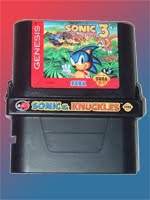
When I think back to the 90s, I vaguely recall hearing or reading about the Lock-On technology of Sonic & Knuckles back then. Basically, Sonic & Knuckles is a standalone side-scrolling platformer that is Sonic's modus operandi; anyone familiar with the franchise (at least, in its earlier years) would feel right at home in this game. However, what makes Sonic & Knuckles truly special is its "Lock-On" design, which allows players to plug either Sonic 2 or Sonic 3 into a slot on the Sonic & Knuckles cartridge. If you plug Sonic 2 into Sonic & Knuckles, you can play Sonic 2 as Knuckles; if you plug in Sonic 3, you can play a combined game of Sonic 3 AND Sonic and Knuckles either as Sonic (with Tails) or Knuckles.

As always, you can play as Sonic, spin-dashing through bad guys, looping up and down paths, collecting rings, and jumping here and here; but, you can also play as Knuckles, a red echidna who can't run as fast as, or jump as high as, Sonic does, but can glide and climb walls with his spiky knuckles (thus, the name). Much of the game is familiar with colorful sprites, catchy beats, and vivid backgrounds, but there are new obstacles, such as green chains that latch onto Sonic or Knuckles and can only be escaped by spin-dashing, and new ways of traversing gaps and tricky spots, such as gymnastics-like metal poles and swinging ropes with bars (which are actually similar to what is in Sonic 2).

Sonic & Knuckles has much of what I've come to appreciate about the Sonic franchise on the Genesis: speedy runs, somewhat reasonably precise jumps, and bright and colorful graphics. Despite these positives, this game, as a standalone, is not without its flaws. One is the music: this is personal taste, but I find the music dissonant and irritating compared to Sonic 2. Maybe, it is because my sons have been playing Sonic & Knuckles lately and have been playing the Mushroom Zone over and over again, so the music has worn out its novelty. Another is the length of each zone: some zones take five to six minutes of game time versus the two to four minutes per zone in Sonic 2. For me, longer zones don't make for a more engaging gaming experience. Yet, the biggest irritation of Sonic & Knuckles is (using a term often employed for describing fighting games) its hit detection. As far as I understand it, if you spin and jump on or at a baddie, the baddie transforms into a harmless forest creature and is defeated, but there have been numerous occasions when I have attacked a baddie in this way and lost all my rings. I suppose that it would be safest to jump on top of the baddie, but I have found that hits are not consistently registered. This makes for some frustration end-of-the-zone battles during which I will spin jump level to the boss, but cough up my rings. This is Velveeta cheese. Conversely, in Sonic 2, there was no such confusion. Of course, I must admit that my account is highly anecdotal; to be sure, I should record how I lose rings or experience zero-ring death to find a pattern.

Nonetheless, Sonic & Knuckles is a welcome addition to my family's Sega Genesis library. The action is rapid and engulfing, and being able to play Sonic 2 as Knuckles is simply awesome. I must warn you, though, that because Knuckles cannot jump as high as Sonic, Dr. Robotnik is more difficult to defeat in end-of-the-zone battles for some zones, like the Chemical Plant Zone, so Knuckles may present a new challenge to those who are used to blazing through Sonic 2 with Sonic and Tails.

Monday, June 6, 2011

Top Ten First-Hand Nostalgia Sega Genesis Characters (2)

So far, I have covered numbers 10 through 3 of my Top Ten First-Hand Nostalgia Sega Genesis Characters. Many of them have been in-game depictions of real-life athletes or celebrities, but a few have been genuine Sega characters, like Ecco and the dweebs from Gunstar Heroes. Going back to picking "real" characters, my number 2 doesn't need much introduction: Sonic the Hedgehog.

Sonic made his debut with the eponymously-titled game Sonic
the Hedgehog, which most Genesis owners acquired by sending away for it along with a cutout of the UPC barcode on the Genesis retail box. Upon inserting and activating the game, players were treated with the exhilarating tones of the Green Hill Zone theme, which has been indelibly etched in the minds of gamers everywhere. Sonic the Hedgehog would prove to be only the beginning of a franchise that would not only spawn multiple titles on the Sega
Genesis, but also on the Saturn, Dreamcast, and now on the Wii and PlayStation - consoles from Nintendo and Sony, which used to be Sega's competitors before Sega fell out of the hardware business.

As a character, Sonic is well-known for brash youthfulness and speed... lots of
speed. But, as one plays any of Sonic's titles on the Genesis, one may find that Sonic is about much more than running fast and liberating forest creatures; Sonic games were based on patient platforming that sometimes required accurate, well-timed jumps and careful navigation through some tricky and frustrating zones. That said, Sonic games were also about kinetic fun, as any fan of the Casino Zone of Sonic the Hedgehog 2 may attest.

Over time, Sonic was joined by numerous characters, the two most notable of
which are Tails and Knuckles. Tails is the two-tailed fox with the uncanny ability of using his tails as helicopter-like rotors to fly; and Knuckles is a red-haired echidna with spiky knuckles and the ability to glide. There are also a host of other characters that I won't mention here, but I must give a shout-out to Dr. Robotnik, who was often responsible for all the mayhem in the Sonic games.

To date, Sonic has endured Sega's cessation of hardware production and has gone on to even co-exist with his erstwhile rival Mario in such games as Super Smash Bros. Brawl on the Wii. It's kind of odd seeing Sonic in the same games as Mario, seeing how they were once mascots pitted against each other. In a way, it was a sad day for Sega when production on the Dreamcast was halted -- it was the end of an age...

You might be asking, "How could Sonic be number 2?" Wait for the final installment to find out!

Thursday, June 2, 2011

Top Ten First-Hand Nostalgia Sega Genesis Characters (10-7)

You know, a common perception of Top Ten lists is that they are highly opinionated, self-indulgent, and personal. I mean, why would I want to know what some guy thought about which ten Van Halen songs were the best of all time? Well, actually, I often find other people's Top Ten lists to be exceptionally intriguing, depending on the subject matter; I get much insight from what others think about stuff in which I am interested.

With that in mind, I have prepared a Top Ten list of the best video game characters I have personally experienced in Sega Genesis games. Why the Genesis? Because I owned one back when it was relevant... and I still own the same one! Now, there are many games I have not played that feature such classic characters as Knuckles, Earthworm Jim, Ristar, Vectorman, Sparkster (from Rocket Knight Adventures), Strider, and the like. I did not include those characters because I have never experienced them first-hand.

Despite this, I do have characters like Sonic, Ecco, and those dudes from Gunstar Heroes on my list, but I also have several surprises (including some in-game depictions of real people) on the list with which you may vehemently disagree (By the way, I will break up the list into four separate blog entries so that you won't be stuck with reading one LONG post). So, here goes -- my Top Ten First-Hand Nostalgia Sega Genesis Characters (10-7):

10) Those Dudes from Gunstar Heroes. These two dudes, whom I will dub Red and Blue, were cute sprites with angry faces that threw, kicked, punched, and blew away any baddie that they encountered. Beyond what they did, these characters were as dull as dirt -- they were just angry dudes that destroyed stuff. Maybe they were angry about the injustices faced by their home planet Gunstar, but the characters were bombastic, monotonous, and gratuitously violent... much like the game itself.

9) Marcus Allbäck (FIFA 97). Back in the day, I was a huge EA Sports game guy, and FIFA 97 found its way into my Genesis library. One of the first teams with which I played was an Allsvenskan (Swedish League) team called Örgryte. On that team was a super-speedy striker named M Allbäck. I didn't know his real first name, so I used to call him "Mats," based on famous tennis player Mats Wilander. But I would later discover that Marcus Allbäck was not only a real player, but he would eventually become an important player for the Swedish national side and play a key role in the European success of FC Copenhagen... Anyway, going back to 1996, Allbäck was a speed merchant who became my most prolific goalscorer and the one player I would often try to acquire whenever I played with another team.

8) Transformable Mecha (Herzog Zwei). Okay, could any American kid who didn't speak German pronounce this game's title right back in the day? My friend Ed and I used to pronounce it "Herzog Zweee," just as one may process American English orthography based on the American English phonemic library and phonological constraints. However, the actual German pronunciation is "Heut-sock tsvai" (IPA: ˈhɛɐ̯tsok ˈtsvai). Pronunciation aside, the transformable mecha controlled by the player was undeniably awesome: you used it to deliver and drop tactical units, you could fly it around to scout what the enemy was doing, and you could transform it into a giant robot to blast away the enemy's tactical units. It was a versatile "character" that was the poster child of one of the first real-time strategy games ever produced, making the character and the game underrated classics.

7) Ecco (Ecco the Dolphin). We all know Ecco -- he's the super-smart and courageous dolphin who has been charged with finding out to where all his sea creature buddies were abducted. He is beautifully rendered, swims fast, has a cool and effective nose attack, and can get some mad hops out of the water. Despite these positives, the plodding, pensive pace of Ecco the Dolphin may be too dull for some, unless you have hours of time to search for answers to arcane puzzles and explore narrow caves and vast expanses of open ocean. Ecco the Dolphin was and is one of the few non-sports games I've played on the Genesis, which is why Ecco rates so highly. Nonetheless, the game may be worth a look, even if the character isn't "exciting."

Stay tuned for 6 to 3!

Thursday, May 26, 2011

Sonic the Hedgehog: 1HN Blast Processing Original

In light of my last post about Sonic the Hedgehog 2, I thought it would be appropos to talk about its predecessor: Sonic the Hedgehog. Back in my college days, I owned Sonic the Hedgehog (heretofore Sonic 1), which was the classic side-scrolling platformer that both started the Sonic franchise and convinced Sega Genesis owners (and wannabe owners) that "Blast Processing" was as real as Sonic's speed runs. At that time, the Genesis and Super Nintendo were duking it out for the top spot in the market; I jumped into the Console Wars in media res, buying my Genesis in Spring 1993. I had received Sonic 1 as a part of send-away offer for only the cost of shipping and handling. However, because I was a huge EA Sports game fan and wasn't interested in platformers at the time, Sonic 1 did more to frustrate me than amuse me, so I ended up selling Sonic 1 as a used game to Electronics Boutique, where I most likely purchased some EA Sports game with the proceeds.

Fast forward to 2011: after having played Sonic 2 somewhat extensively, I regret my impatience with Sonic 1. Sure, Sonic 1 didn't have Spin Dash or Tails or many of the speed parts of Sonic 2, but Sonic 1 has three advantages over its successor: Sonic 1 was THE original, which carries with it a unique sense of nostalgia; though the 3D-perspective bonus stages in Sonic 2 are fun and challenging, the bonus stages in Sonic 1 present a directional challenge that appears to be absent from every other Sonic game; and, it is the cheapest cartridge to buy among all the Sonic titles for the Genesis right now... If you perform a search for Sonic Genesis games on eBay, you'll see this bear out.

In any case, Sonic 1 is still an excellent platformer with much to offer to the wayward gamer, such as creative level design, bilateral movement (i.e. you can go left to right to left, which was new compared to Super Mario Bros. 1), and, honestly, superlative 8-bit music (Yes, I said "8-bit music" -- the Genesis had a 16-bit processor, but an 8-bit Zilog Z80 sound controller). More importantly, Sonic 1 raised the ante in the Console Wars between Sega and Nintendo by both giving Sega a marketable mascot and a viable rival in gameplay and presentation to the Mario series of games on the NES and SNES. For all of these reasons, if you have a chance, buy Sonic 1; I'm sure you won't regret it nearly as much as I regret having sold it for some forgotten EA Sports game.

Wednesday, May 25, 2011

Sonic the Hedgehog 2: ?HN Speed Ringer

It's the Christmas of 2009. Wanting to expose my young sons to games from a more innocuous gaming era, I bought Sonic the Hedgehog 2 and gave it as a Christmas present along with several other Genesis and NES games and a Gen-X Dual Station clone console. I am not sure if I had played Sonic 2 before that time, but the presence of Tails seemed to trigger a latent memory from long ago... In any case, my boys really enjoyed Sonic 2 because it was fast, you could make tons of mistakes and still survive, and the first levels are really easy. The level of difficulty gets ramped up, though, as soon as Sonic and his buddy enter the Chemical Plant Zone. From there, the platforms become harder to land on and speed, if used at the wrong time, can kill more than it can help.

Sonic the Hedgehog 2, like its predecessor, Sonic the Hedgehog, is a classic game. Some fanboys acknowledge it as the best of the Sega Genesis era, though some may tout Sonic 3 ahead of it. With everything from the standstill Spin Dash (which you perform by pressing down on the D-pad and tapping any one of the Genesis controller's buttons repeatedly) to more speed parts (e.g. a lot more loops, bumpers, and slopes to dash down) to Tails (who is especially helpful when a second player grabs the controller at the end portions of each zone where Sonic fights Dr. Robotnik), Sonic 2 introduced many of those Sonic gameplay aspects many have grown to love. Yet, Sonic 2 can also be frustrating with the underwater zone (and the need to catch air bubbles before drowning), annoying critters that shoot barely visible projectiles that cause Sonic to burp up all his rings, irritating jumps that can be difficult because of Sonic's inertia (think Chemical Plant Zone), and Tails (who dies endlessly at any obstacle). Nonetheless, for a seasoned platform gamer, this game is essential.

All of that said, it wasn't until recently that I began to appreciate platforming games. Back in college, I had no patience for the pinpoint accuracy some of the jumps in platformers like Sonic 2 and Super Mario Bros. required. I also couldn't stand the monotony of level after level of moving platforms and hazards -- at least, that is what I used to think. Now, with sports games ascending to a new height of gameplay difficulty, platformers have an inherent simplicity that is refreshing and escapist. For these reasons, I now enjoy Sonic 2, though I must say that with all of his speed and coolness, Sonic is a less accurate jumper than Mario of Super Mario World. Compare the two games: you'll find that there is a lower margin for error in Sonic 2 than Super Mario World. Just an observation...

Friday, August 6, 2010

Mega Man X: 2HN Stiff Shooter

Back in the mid-90s during my college days, I was a loyal Genesis player, particularly of EA Sports games on that console. Occasionally, I bought and tried other games, like Sonic and Ecco the Dolphin. While I wasn't an ardent side-scrolling platform game player, I respected them enough to acknowledge them.

Today, as I plumb the depths of not only platforming side-scrollers, but also Super Nintendo games, I stumble upon games that even gamers now hold in high regard. One of those games is Mega Man X, which was one of Capcom's early SNES releases after a successful franchise run on the NES. In college, I wasn't directly aware of Mega Man X, but I did recognize the Mega Man character, who I believe is robot boy/man made out of metal. This recognition compelled me to buy the game from a co-worker, who happens to still own SNES cartridges.

Mega Man X starts up with a rocking soundtrack and the main character "X" leaping into the title screen. The game looks good and sounds great, but when I started playing I realized something: I can't duck! I can jump, I can shoot, but I can't duck! And, I can't shoot at a angle, which means that I have to jump to shoot. This is how it is in the first stage: X is capable of firing charged beams, jumping or sliding off walls, and jumping. There is no turbo run, no ducking, and no angle shooting from the start; the lack of such abilities sometimes led to character death. Super Metroid gets this right, but it appears that X has to gain certain abilities as he finishes missions, such as sliding on the ground. I haven't investigated what other abilities X can inherit, but you don't start off ducking and that bothers me.

After I passed the first stage and endured an "event battle" (i.e. a battle you are destined to lose, but must happen to advance a paper-thin plot), I found myself able to choose which stage I could try out. Which stage do I do first? I don't know, but apparently there is an optimal order because some stages are harder than others without certain upgrades. If any game needed a walkthrough, Mega Man X is such a game. How about an indication of which stage is "Stage Two?" No such indication, sadly.

Overall, the look and sounds of Mega Man X are awesome, but the gameplay is stiff and restrictive from the beginning. I've heard that this is how Mega Man games were on the NES, so I can see why my friends never recommended it (if the stiffness was the reason). I must compare it to Metroid; even on the NES, you could angle your shot up or diagonally up, and you could duck. With X, all you can do is jump to avoid missiles, rolling robots, and other baddies. Why Mega Man X is a classic is beyond me.

By the way, in Mega Man X, you blow up robots with your arm cannon. This technically qualifies as violence, but there is no blood though X writhes in agony whenever he's shot. If this game sits well with you, you could try it out, but be prepared to be a little frustrated.