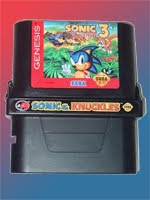
Showing posts with label Genesis. Show all posts

Wednesday, February 5, 2020

Madden 93: 1HN Hammer Redemption

Last night, I pulled off what I had never thought I would actually do, despite the numerous opportunities that were granted me in the past: I bought the Sega Genesis game cartridge for John Madden Football 93 (or Madden 93). Several months ago, I had spotted it in a local retrogame store; believe it or not, there is a store dedicated to retro video game cartridges in my town! Feeling a bit down about my prospects of an X-Wing Miniatures Game match being shattered as my sparring partner comforted his distraught friend, I ventured to that store and, for seven measly American dollars, I acquired that once long-lost gem for myself. To be honest, though, it wasn't really "long-lost," as much as it was destroyed in a fit of anger. I shall elucidate...

During my second year of college, I purchased a Sega Genesis Model One from KB Toys in Los Angeles. At the time, the Model One Genesis was on sale for $129 or something like that, and I knew that this was a great deal. I had wanted a Genesis for some time, having been the owner of a Nintendo Entertainment System which had been long outmoded by then. Throughout my high school years, my friends Ed and Tim owned a Genesis. We used to spend evenings playing various games, especially Madden 92 (I wrote a post about that). After acquiring that magical piece of 16-bit hardware, I meandered home and plugged it into my old CRT television with the provided RF adapter. I inserted my first game cartridge, Sonic the Hedgehog, and fired up the console. Sure enough, the Genesis was as fun as it was during my high school days.

I don't remember exactly when I acquired Madden 93, but I know that by 1994 (when I acquired the Genesis), it was an older game. Nonetheless, I bought it and played it numerous times with Ed, who was one of my roommates at UCLA. One of my all-time favorite video game memories was playing alongside Ed as the 1985 Chicago Bears. We may a simple rule for ourselves to enhance the challenge of playing against the computer: we could NOT score on offensive plays. We could score after an interception, a fumble, a punt, a kickoff, or as a result of a safety; otherwise, we had to punt the ball. We experienced some hilarious scenarios. One scenario was after we would intercept the ball, run it to the opposition's 4-yard-line, and then get tackled; because we couldn't score on offense, we had to punt, so we had to angle our punt to the sidelines AND kick with as little power as possible to move the ball to the 1-yard-line! Another funny scenario was trying to rush the quarterback at the same time only to have both of our sprites dive past the fortunate quarterback. We used to shift the defensive line off to one side and rush from other other side. We also got really good at batting down passes... I don't know if we could win in a modern football game in this way, but I can say with certainty that doing so wouldn't be as delightful as it was with Madden 93 on the Sega Genesis.

Anyway, as my second year of college came to a close, I moved out of the apartment I shared with Ed and moved into a studio apartment with Chris. To summarize very briefly, Chris and I were like oil and water; we didn't mesh very well. In retrospect, I recognize that he was a very nice guy and was more selfless than a lot of college students, but our senses of humor were very different to the point where his sarcasm offended me to the core. Because he was my roommate, he would sometimes challenge me in a sports game on the Genesis; usually it was NHL 95 or Madden 93, which I was still playing despite my owning Madden 94 (in my opinion, the game quality got worse between Madden 93 and Madden 94). During those games, Chris was highly proficient at mind games. For instance, if he were losing, he would say, "Oh, I had to scratch my arm, so I messed up that play," as if my winning were accidental; conversely, if he were winning, he would tout his video game greatness. It used to wear on me like the proverbial nails on a chalkboard. One day, Ed visited me and made an off-hand comment about Chris. For reasons I still do not fully understand, I was enraged at being reminded of Chris, so I proceeded to smash my beloved Madden 93 cartridge with a hammer and threw the entire package down the garbage chute.

Thus, I destroyed the cartridge. That was 24 years ago.

For years, I regretted my rash actions. It was very counterproductive for me to annihilate my own property, but to do so with a game I thoroughly enjoyed was an especially poignant regret. Up until the end of my college days, I had a problem with anger that occasionally drove me to destroy things. Even as a born-again Christian now, I am still plagued with this rage, but I do not wreck things as I used to do. It is a tendency that I endeavor to eliminate in my character.

Fast-forward to last night. After I purchased Madden 93 for the second time, I feel as if I have corrected a past mistake. I know that God is not concerned with wrecked cartridges or video games, but I would like to think that He chose to bless me with it again. I vow to care for this cartridge and enjoy it again with Ed, as well as my sons.

By the way, regarding the game itself, it is one of the easiest football games to learn in the world of video games, especially compared to Madden games on the XBox or PlayStation. With three buttons and a directional pad, Madden 93 on the Sega Genesis is fun, fast, and readily accessible. Also, you receive the benefit of learning about American football. Of course, you would have to accept that in 1993 there were no two-point-conversions, Texans, Ravens, or Titans. Set those differences aside and you're in for a night full of entertainment.

To quote John Madden: BOOM! He'll remember that number!

Friday, May 30, 2014

NBA Jam: 2HN Basketball Buffoonery

During my UCLA days in the early to mid-1990s, the video game console wars were in full effect with Sega and Nintendo jockeying for the top spot in the marketplace, specifically the media war between the Sega Genesis and the Super Nintendo. At the time, people either owned one or the other and rarely owned both, as if either company loyalty was that important or consoles and games were just too expensive to invest in two separate systems. As consoles became closer to arcade quality in their presentation of graphics and sound, video game cabinet manufacturers seemed to up the ante, having already introduced laserdisc-based games like Dragon's Lair and Firefox (based on the Clint Eastwood movie) and rolling out games with superior graphics, sound, and two-player gameplay like the once-ubiquitous Street Fighter II, Mortal Kombat, and NBA Jam. Initially, Sega and Nintendo, though capable of (then) superlative home-based video games, struggled to convert arcade-based games like Street Fighter II and NBA Jam to their consoles... but they eventually succeeded with differing results. While Nintendo (and, to some extent, Sega) did well to port Street Fighter II to the Super Nintendo, NBA Jam was not nearly the game it was in the arcade.

For anyone who wasn't born before 1990, let me introduce you to the concept of NBA Jam: it's essentially two-on-two basketball with 1990s NBA basketball stars. Do you like the Lakers? Well, you can play with James Worthy and Vlade Divac. Do you like the Golden State Warriors and long for the days of Run-TMC (Tim Hardaway, Mitch Richmond, and Chris Mullin)? Cool, because you could play with Hardaway and Mullin. Oh, you say that you love the Bulls? Of course, you can play with Michael Jordan and Scottie Pippen... or NOT! Instead, you got Pippen and Horace Grant. How about Orlando Magic? Okay, you got Shaquille O'Neal, but you only got Penny Hardaway depending on which console you played the game. Much of who appeared in NBA Jam was dependent on licensing issues and the issues individual players had with royalties and such monetary concerns.

When it came to gameplay, it didn't matter with whom one played because NBA Jam was all about two things: thunderous dunks and fiery three-pointers. The fun of this game was in its uncomplicated, yet undeniably cheesy gameplay which often went like this: with one of your players (it really didn't matter who), you dribble the ball up the floor and either pass to your other player and dunk with heart-pumping authority or you loft a three-pointer from "way downtown." The first dunk of a streak of dunks was rather perfunctory, but the more a particular player dunked, the more acrobatic and gravity-defying the animations became. Likewise, the more a player drained three-pointers, the more the ball would burst into flame and the console or arcade cabinet's speakers would declare that he was "ON FIRE!" or "En fuego!"

The graphics of NBA Jam in the arcade were bright, garish, and eye-popping with each player looking like bobbleheads that are handed out at baseball stadiums as promotional items. Besides that, the uniforms of the players were shadowy reflections of the real-life uniforms, though the home floor of each team was emblazoned with that team's logos and colors to remind us that this WAS the NBA. What was even more indelible in my memory, however, was the sounds of the game: the crowd cheering, the realistic screech of sneakers on hardwood, and the play-by-play announcers' exclamatory remarks all created a hyper-realistic feel that went beyond anything one would watch during an NBA game on television.

In the 1990s, NBA Jam was ever-present in arcades on UCLA's campus and in local arcades and amusement centers I used to visit. I may have played the arcade version of the game once or twice on a lark, but I don't remember doing so. Yet, I'll always recall the NBA Jam announcer blurting, "Rony Seikaly... for three... He's on fire!" even though Rony Seikaly was not known for his three-point shooting. People used to line up their quarters to challenge the reigning player in the arcade; those battles were certainly fun to watch, at least for a few minutes. I never really developed an interest in NBA Jam, but I appreciated its presence in the arcades, at least because the game only added to the animated, noisy buffoonery that was, and still is, inherent to the video arcade lifestyle and motif.

Just last weekend, my wife and I happened upon a garage sale in one of the older homes in our area. Being a semi-avid video game cartridge collector, I reasoned (and hoped) that this older home would have a treasure trove of older games and consoles because the older homes were where peoples lived long enough to accumulate junk from the 1990s and before. Sure enough, I rummaged through a box of discarded and dusty game consoles to find a filthy Super Nintendo console and two cartridges: NBA Jam and Super Mario World 2 (about which I will write later). Both cartridges set me back a few bucks, which I handed to the homeowner with a thin veneer of calm hiding the unrepentant joy and enthusiasm that welled up from within me. Those cartridges were an uncommon find, especially now when savvy sellers are well-aware of the value of retro game cartridges on eBay. I gleefully took both cartridges home, gingerly yet aggressively cleaned the copper pins with Windex and Q-Tips, and washed the outsides of both cartridges with some Greased Lightning and a microfiber cloth. Thankfully, I got both cartridges working in my trusty Retro Duo.

I discovered two things that day: one was that Super Mario World 2 was as awesome as what I had read in a couple of reviews; the other was the NBA Jam on the Super Nintendo was a poor imitation of the arcade version. I played NBA Jam on the SNES for a few minutes to "test" the game's functions and playability and, sadly, found it dull compared to EA Sports' NBA Live series of games. It was just pass-pass-dunk, pass-pass-three, pass-pass-have ball stolen-watch as the computer dunks on my flailing sprites. Oh well... At least the cartridge was cheap and buying it triggered enough of those nostalgic feelings about the arcades of my youth to offset how mediocre NBA  Jam for the SNES was, and still is.

Tuesday, March 19, 2013

Nobunaga's Ambition: 1HN Confusion in Defeat

When I was an undergrad, I studied Japanese language, history, and culture. Admittedly, at the time, I wasn't much of a language student and much preferred the elective history classes I took over learning kanji and memorizing dialogues. One day, while I was browsing the game stacks at Electronics Boutique, I happened upon Nobunaga's Ambition, which instantly caught my eye because of my appreciation of Japanese history, particularly the warlord period before the Edo/Tokugawa period (1600-1868). It was during that period when Japan's three greatest warlords brought about events that would unify the Japanese archipelago. This game focuses on the time period of Oda Nobunaga's rise to power. He was the first of the three great warlords (who were technically not "shogun," but are often considered as such) and was probably the most fascinating of the three for his penchant for megalomania and ambition to establish himself as a leader to be worshipped.

Even knowing a little about Oda Nobunaga should interest anyone in a strategy game about conquering domains, forming alliances through marriage, and conducting trade, which is what Nobunaga's Ambition promised as a game. I remember when I first opened the game and inserted it into my Sega Genesis. I actually perused the rather substantial manual -- I didn't just scan it, but read it deeply. I started the game and duly chose to be Oda Nobunaga. I was assaulted with the bright 16-bit glory of Genesis graphics and inundated with information about my domain and my military strength. Things started out so well and I was fully prepared to engage in hours of strategic gaming...

Except it didn't last hours. In fact, my first game didn't last more than 10 minutes because in short order I invaded a neighbor, got routed, tried forming an alliance and failed, and then got routed by another neighbor who took advantage of my weakness. I recall not being upset or frustrated, but confused. What just happened? What on Earth could I have done?

Well, I tried again... and again. At the start of one game, I tried to boost my rice production and go with a trade strategy, but I would inevitably be tempted to expand militarily and be summarily slapped down. I would then try to stockpile my fighting units only to be taken out from all sides due to my refusal to act. There were some strategies I refused to try because I didn't agree with them, and probably failed as a result; one such tactic was marrying into alliances. Because it seemed dishonest to me to establish alliances only to break them, I never tried that approach, though it could have been a route to victory. (Actually, Japan was largely unified through alliances, diplomacy, and the Battle of Sekigahara, which wasn't a direct military victory for Tokugawa Ieyasu as much as it stoked the formation of a political coalition among the victorious domains). Anyway, I tried several tactics and avoided other tactics, but the results were always the same: failure to advance.

The common response to repeated failure in strategy games is to seek out whatever tips, tricks, and information out there to play and win, but because I was more of a sports gamer at the time, I didn't have the patience to find strategy guides to win at what was essentially a resource management game. In little time, I shelved the game, never to crack the case again. Today, I still own Nobunaga's Ambition. As I write this, I think about how my new-found interest in Euro-style board games, which has stoked a parallel interest in Nobunaga's Ambition. Perhaps I was in the wrong place at the wrong time with this game: as a 22-year-old sports fan, the game was too slow and too opaque for me to sit back and enjoy it. However, as a 38-year-old board gamer, I think I'll try this game again. With the Internet and mounds of potential strategy information at my disposal, I can approach the game with a renewed vigor, with optimism, and with an appreciation of the management of resources. Stay tuned for Part II, when I give Nobunaga's Ambition another try...

Tuesday, November 20, 2012

Appreciating the Great to Discern the Derivative


As time passes, it is confirmed for me, again and again, that the simplicity and pick-up-and-playability of "old" video games is vastly superior to the glitz and graphics of today's three-dimensional offerings. Sure, one may marvel at the visual explosion of garish hues of any PlayStation game, or guffaw at the side-splitting and muscle-tearing action of XBox Kinect or Wii games, or even be wowed by the audio saturation emanating from one's quadrophonic sound system as one plays games... well, on any of those consoles. However, I find that it is difficult to trump the quaint jaggedness of 8-bit or 16-bit sprites, the plip-ploppiness of 25-year-old game sound effects, or even the mind-bending elegance of one D-pad and two, three, or six buttons.

The reason why I am waxing nostalgic and gushing with needlessly verbose prose is because I experienced a moment of peculiar lucidity today. During a work training session, rather randomly, I asked one of the attendees (who happened to be my age) if he remembered the infinite-life trick in Super Mario Brothers for the NES. For a few seconds, the attendee (who was attending via WebEx, actually) admitted some ignorance, but then corrected himself and recalled with impressive clarity that if you jump on a certain creature (in this case, a Koopa) a certain way (on the edge of its shell as it descends stairs made of blocks), you can set up an infinite loop of life gain. Floored by his apparent recall of that tactic, I filled in the blanks of his description by noting that it happens in World 3 and results in cryptic symbols replacing numbers next to the Mario life indicator that is displayed before the start of each level.

As this moment of lucidity passed, I was reminded that though games like Super Mario Brothers were easy to learn and somewhat challenging to conquer, there were arduous aspects of the gameplay that made even seasoned gamers pause, such as trying to advance anywhere in Legend of Zelda; also, there were wondrous moments of revelation that etched indelible impressions in our psyches, such as the infinite life trick. What was revealed to me was that while the simplicity of those old games lured us into becoming fans, it was the hidden and the discoverable that kept us returning to play over and over. There was something eminently rewarding about unearthing such tricks or conquering levels of ridiculous difficulty. I contend that games today, even with their Easter eggs, hidden levels, and downloadable content do not have the payoff of  the infinite life trick, of setting the correct tree on fire, or climbing the once-inaccessible tower to find a 1-UP (a la Knuckles the Echidna). I suppose it's because these games live in the rosy-tinted world of my memories. However, when I watch my sons play the old games or I hear a co-worker describe his son's admiration of Super Mario Brothers, I realize that if we all bring up our children to appreciate the things of the past, we bless them with the gift of discerning what is great from what is derivative.

Monday, May 21, 2012

Simplicity: 1HN Better than Realism

Today, a wistful feeling has overcome me. As I see events unfold around me, I am disturbed and deeply saddened by how my beliefs are challenged and I am viewed as anachronistic and a relic for what I believe...

I'm talking about video games, of course...

Granted, some things haven't changed much since I received my first video game console (a Colecovision) thirty years ago. One thing that hasn't changed is the general popularity of video games. Back in the early 80s, Atari, Intellivison, and Colecovision were extremely popular as game commercials dominated the airwaves, store shelves were well-stocked with games, and most of the kids I knew had at least one of those systems. When the Nintendo Entertainment System came out in 1985, it was an even bigger deal; I have indelible memories of ROB the Robot and Excitebike from times I spent at my friend Brian's house. Fast-forward to now, video games are still popular among the young and now the old, as well. Another thing that hasn't changed is how video games can bring disparate social groups together. Whether it be Starcraft across the Internet or a bunch of neighborhood kids huddled around a Wii, video games unify people. A third thing that hasn't changed much is the characters. Thanks to the staying power of such icons as Mario, Sonic, Snake, Samus Aran, the Belmont family, and Earthworm Jim (he's still popular... right?!), the nostalgia of the past lives in the gloss and sheen of the superior graphics and sound of the present.

However, much has also changed with the passage of time. Some may argue that games nowadays are not as "hard," and that you don't need the practice and precision of past games to master today's games; but some may counter and say that games as less "cheesy" than, say, Ninja Gaiden II or Rush 'n Attack (of which I have a fond disdain). Some may opine about the realism of first-person-shooters and how games just seem more violent today, while some may respond that games are no less violent today than 8-bit shooters like Contra or Metal Gear; "It's not that games are more violent, but that they're just more graphic," some may observe. There is also the complexity of games today, in which you can play for hours on end and barely stratch the surface of a convoluted storyline; conversely, you could finish The Legend of Zelda in eight hours or so (which would be insane, but still...).

One cannot argue with the cliche that "the more things change, the more things stay the same." Yet, as I watch the visual and auditory quality of games escalate with improving technologies, and the sheer number of buttons and analog sticks increase with each new in-game function, I am reminded that today's games lack something that past games had in spades: simplicity. Remember the Atari 2600 with its one joystick and one button? I challenge you to find an easier game to learn, but harder game to master on the Wii than Pitfall was on the Atari with just its one button. Remember the NES with its two buttons, or the Sega Genesis with its three buttons? Remember how easy it was for an inexperienced friend to come over and play games with (or against) you on those consoles because the controls were easier to master? I challenge you to train your inexperienced friend about how to play any current EA Sports game on the XBox and its ten buttons...

Besides simplicity, which factors into what I am about to state, games of the past seem lighter by today's standards. Whereas now one can get lost in a game world and not emerge for days, I could play a Genesis game for a couple hours and then walk away and enjoy the rest of my day. In this way, games today are immersive to a fault. Of course, some may argue that The Legend of Zelda or other older RPGs were the same way, but I could walk away after a few hours. Try doing that with Mass Effect or any of those story-based games... It's difficult.

But, the most apparent difference between the games of the past and today's games is the creativity it took to render great games with such comparatively poor resolution. Compare Super Mario Bros. on the NES to Super Mario Bros. on the Wii; obviously, the Wii trumps the NES big time, but think about the limitations those Nintendo programmers had to overcome to render a classic game on the NES. For the Wii, on the other hand, the developers had much more to work with when it came to graphics and sound.

Upon reflection, my wistful feelings about video games come from remembrances of more carefree times with friends in high school or college when we sat around and laughed at buddies messing up in a game, or discussed strategy or if the Genesis or the SNES versions of games were better. I suppose that kids today may look back on 2012 when they're adults and feel the same. The interesting thing I've observed, though, is that there is a fervent attempt to make games simpler with motion capture, as with the XBox Kinect and the Wii's long-in-the-tooth wand-based controls. Perhaps, we are seeing a renaissance of simplicity in gaming, pulling in a new generation of youngsters, but I contend that the retro-charm of jaggedly rendered 8-bit characters will always transcend the smooth textures of today's sprites because, as with many things in this world, we will always look backwards and remember we could walk away from a couple hours (or less) of play and be satisfied, while one often fills the day with gaming today to get their fix. In this way, realism isn't always good, and I am saddened to see that people today put that much stock in the realism afforded to us by stellar graphics and movie-quality sound when video games are best played as a brief escape from reality.

Thursday, February 23, 2012

Madden Football 92: 1HN Friend Cash Pool

This blog entry is not as much a review of Madden Football 92 for the Genesis as a recollection of personal events related to the game. Mind you (the reader), I played Madden 92 numerous times with my friends Ed and Tim (who are brothers), so this game is indeed 1HN (first-hand nostalgia) for me. But, what makes this game stand out in my mind is the circumstances under which we purchased it.

It was fall of 1991, and Ed and I were seniors in high school. It was one of those Saturdays when my mom and dad let me crash at Ed's house. There were many great things about crashing at his house: I could be loud if I wanted; his parents were very easygoing; Ed was simultaneously hilarious and mildly irritating; and, Ed had a Sega Genesis. In those days, I still had my NES, but had given up on it because, hey, I was in high school and I didn't have time for that "kiddie stuff." Having said that, the Genesis was certainly NOT kiddie stuff; this was a serious cutting-edge gaming console. I remember the day when Ed brought over the Genesis with Altered Beast to my house. I was blown away, to say the least.

Anyway, I was hanging out with Ed and his family when Ed started to scheme. See, he and Tim knew that Electronic Arts had released Madden Football 92 for the Sega Genesis and they were pooling their cash to buy it. They were a bit short on cash, but I had some. I think now that it was odd that I willingly contributed a share of cash to help them buy a game I couldn't play at my own home, but I quite enthusiastically offered to pay a third of the cost just so that they could buy the game that night. With sufficient funds in hand, Ed, Tim, their dad, and I piled into their dad's battleship of a brown station wagon and made the five-mile journey to some mom-and-pop video and game store.

When we arrived, I noted the dark-wooded trim of the mini-mall dating back to the late 1970s. After we parked, Ed made a beeline into the store where the game was located. I looked around inside the store and considered the relatively small space. There were videos and games lining the walls. I remember thumbing through some CD singles where I found "Nobody's Fool" by Kenny Loggins, which was the main theme from Caddyshack II. I put the single aside and turned to watch as Ed and Tim purchased Madden 92. Ah, our prize... Finally in our grasp!

I remember getting to hold it and looking at the blue-bordered front cover of the cartridge box. There was John Madden with his Super Bowl ring and microphone, mugging for the camera as if he had just finished some color commentary. I also recall going back to Ed's house and waiting eagerly as Tim inserted the cartridge into their Genesis.

Madden Football 92 for the Genesis was a wonderful pick-up-and-play football simulation that amounted to hours and hours of fun. Ed and Tim used to record statistics when they pitted specific teams against other teams. They even kept season standings as if they were NFL commissioners. I marveled at the stats they would keep and their diligence in recording those stats. I could never be so motivated to retain stats from a sports game like they did, though I would certainly fret over rosters in other sports games. In any case, Madden 92 represented for me how video games could bring friends together and, ironically, encourage social interaction. Ed and I used to spend hours playing or watching games, goading each other or laughing at the ridiculous plays that the Genesis CPU would conjure out of thin air. Did Ed ever pay me back, I wonder... Even if he didn't, it was worth the cash just to spend time with my friends.

Friday, January 13, 2012

Super R-Type: 3HN Mindless Frustration


Call it a compulsion to extend my family's classic game collection or an odd desire to expose my boys to the finer, less modern games out there, but I'm always on the lookout for classic Super Nintendo or Genesis games. I read reviews and watch players' recorded longplays to isolate those games that exemplify the best of those consoles. Sometimes, I hit gold with games like Super Metroid or Super Mario World, but I also encounter duds, like OutRunners (which I may review in the future - it's a dull, split-screen racing simulation on the Genesis). Before Christmas, I turned my sights on side-scrolling spaceship shmups (shoot-em-ups) because our collection didn't feature one. There are several out there, including the venerable Gradius series and the R-Type series (both of which spanned the NES and SNES). I vacillated between Gradius III and Super R-Type for the SNES; what swayed me towards Super R-Type was the price on eBay, where it was 50 cents cheaper that Gradius III. I must admit that this is a dumb reason to choose between games, but I bought Super R-Type, wrapped it up, and gave it to my sons as one of many Christmas presents.

Okay... I'll just summarize my thoughts: Super R-Type is poor. Yes, the graphics are colorful, the aliens are eerily eye-popping, and the in-game sounds are crisp. My issues with this game are not the presentation of it, but the gameplay. As one may expect, side-scrolling shmups are no-brainers: you fly, move top to bottom, shoot things with your basic weapon, acquire stronger weapons, and then blast more baddies to smithereens with those powerful, acquired weapons. Super R-Type is no different, but (as far as I can tell) you only use three of the six available gameplay buttons on the SNES controller - that's a waste. Also, I must say that the second mini-boss is just too HARD to beat; I had to watch someone else's longplay on YouTube just to figure out how to destroy that spinning metal gyromite (Do you like the NES reference?). The first level should ALWAYS be a breeze when the game is set to the EASY setting; but, in Super R-Type, I have yet to get past it, so one can imagine how discouraged my boys were playing the game.

Super R-Type is almost exactly what I would expect from a side-scrolling space shmup: one lone ship, some power-ups, endless squadrons of baddies, and loads of mini-bosses. Considering this, I cannot fathom why I felt it necessary to add such games to our family collection because, honestly, I have always found them dull and pointless (except for Zanac, which continues to grow on me). My boys seemed to agree as they gave up on the game after 10 minutes of frustration. I can't blame them, though I will revisit this game in a feeble attempt to pass that second mini-boss. So, don't believe the hype. My advice is to stay away from side-scrolling space shmups, and avoid the confounding, mind-numbing blandness of Super R-Type.

Tuesday, August 9, 2011

Ecco the Dolphin: 1HN Thinker

In the early 90s, when the Sega Genesis was at the height of its popularity, Ecco the Dolphin showed up as a rather odd bird among the stable of Genesis games. While there were action games like Altered Beast and Strider, as well as sidescrolling speed demons like Sonic the Hedgehog, Ecco came along as the antithesis of those games: ponderous, languid, yet somewhat eerie and unsettling. Ecco the Dolphin was a side-scroller with no platforms, no-power-ups, and no weapons; instead, it featured puzzles, checkpoints that required problem-solving to pass, and maze-like underwater passages that threatened to drown your wayward dolphin if you didn't find air in a timely fashion.

Ecco the Dolphin begins with you as Ecco, blissfully swimming in your lagoon and conversing with other dolphins using echolocation. Suddenly, a unexpectedly terrifying gale whisks your fellow lagoon inhabitants up into a whirlwind, leaving you alone. From there, the game begins with you leaving your lagoon, asking questions of any passerby that you encounter, and progressing from stage to stage by pushing shells with your snout, vanquishing jellyfish or other baddies with said snout, and navigating through tight spaces and wide expanses whilst shooting up to the surface (or into a convenient air pocket) occasionally to replenish your air supply. All of this occurs with the overriding goal of trying to find out where your fellow lagoon compatriots went and why they were abducted.

As a character, Ecco possessed abilities that offered the promise of fun and excitement for the gamer: he could swim at high speed, thump enemies with his snout, execute some cool jumps out of the water, and communicate with a high-pitched blast. Yet, Ecco the Dolphin was strikingly different from many games of the time because of its languid pace and somewhat somber tone, as well as the emphasis on overcoming impeding obstacles. In some ways, this game evoked a feeling that was somewhat similar to some of the zones in the original Metroid on the NES, where you had to search continuously to find that hidden power-up or that passage that would take you to another area, but at a slower, more deliberate pace. Thus, despite the potential for action, the emphasis of Ecco the Dolphin is on your ability to successfully navigate through zones to find answers to questions that become more apparent as the game progresses.

When I bought Ecco the Dolphin in the early 90s, I didn't know what to expect; I just knew that there was much hype about this game on TV and in the magazines I read. After I bought the game and played it for a while, I was impressed by the vibrant graphics, the detailed sprites, and majestic, albeit dated, synthesized music that evokes an unnerving feeling I came to associate with games like Myst. Sure, Myst was a point-and-click game with stills and embedded puzzles, but that uncertain feeling of not knowing where I am going or what I was supposed to do was the same for both games. At the time, I didn't have the patience to complete this epic game, even though it had a password system which would allow me to return to the game later. Nowadays, with a family and a full-time job, Ecco the Dolphin is way down the queue of things I want to do, even on the list of games I allocate time (if I have time) to play.

I recommend this game if you are looking for a game that immerses you (literally) in a strange underwater realm which you must explore armed only with your wit and a boatload of patience. For kids, this may also be a good game because the game requires problem-solving, the violence is only for survival (such as when smacks of jellyfish drift into your path), the focus on marine life may spark an interest in the sea and its flora and fauna, and the pace isn't a sugar-soaked, frenetic one. If anything, Ecco the Dolphin compels you to appreciate the nuanced graphics and sound inherent to the game. My only caveat is that (spoiler alert!) aliens play a role in this game; if you are wary of the concept of the supposed existence of aliens, you may want to speak with your children before playing Ecco the Dolphin.

Thursday, July 14, 2011

Sonic the Hedgehog 2 as Knuckles: 3HN Tips and Tricks

Among all the Sonic the Hedgehog games for the Sega Genesis, some gamers put Sonic 2 on top, even over subsequent releases like Sonic 3 and Sonic & Knuckles (S&K). This may be for several reasons: Sonic 2 added Spin Dash, more speed loops and runs, and Tails to the Sonic 1 formula; the zones are much shorter than Sonic 3's or S&K's zones; the end bosses are challenging but beatable compared to the nastiness of S&K; and, in my opinion, the music for Sonic 2 is much more memorable than past and future offerings (save the Green Hill Zone music of Sonic 1, which is iconic). But, there is something even better than Sonic 2 on the Genesis: lock Sonic 2 onto the Sonic & Knuckles cartridge and you get to play Sonic 2 as Knuckles the Echidna, who can glide and climb walls, but runs more slowly and jumps lower than Sonic.

Knuckles brings a fresh approach to Sonic 2 that opens up new tactics and options for navigating zones. Here are some of the tricks I have learned while playing Sonic 2 as Knuckles:

1) In both of the Emerald Hill Zone acts (i.e. levels), you can glide over most of both acts by accelerating at the beginning and then gliding. Just to get through the Emerald Hill Zone quickly, this tactic may be worth the attempt.

2) Unlike playing Sonic 2 as Sonic, when you play as Knuckles, you do not lose your ring totals after going into Special Zones to try to claim Chaos Emeralds. With this in mind, you can conceivably get four emeralds in those two acts. I recommend doing this instead of trying to retain rings in more difficult zones that follow.

3) In the Chemical Plant Zone, be sure to climb all the high places you can find. These places are added to Sonic 2 by the extended programming in the S&K cartridge to not only provide Knuckles with areas to climb and obstructions to prevent his gliding through the zone, but also with areas to house 1-ups and power-ups. In the second act of the Chemical Plant Zone, you can find at least two 1-ups inside tower-like structures that Knuckles must scale to get.

4) In the Aquatic Ruin Zone, stay well above the action below by gliding and running on the higher platforms. The two acts of this zone are notorious for its extensive stretches of submerged landscape, which require Sonic (or Knuckles) to find sources of oxygen before he drowns. With Knuckles, though, you can remain high above the water for some of those stretches if you glide.

Well, these are the tactics I have used so far and they've been quite effective. Playing Sonic 2 as Knuckles takes a superlative game and enhances it. In time, you may find that you prefer playing Sonic 2 as Knuckles... or you may get "nostalgic" for those days when Sonic and Tails conquered the Emerald Hill Zone and teamed up to defeat Dr. Robotnik's Love Buggy at the end of the zone. Good times.

Thursday, July 7, 2011

Maui Mallard in Cold Shadow: 3HN Duck Disappointment

In one of my previous posts, I dubbed the Disney character Donald Duck as the top Sega Genesis game character in terms of personal nostalgia; with a tough and determined demeanor that belies his Disney cute factor and with underrated winners under his belt like Quackshot and World of Illusion, Donald Duck has certainly earned the top spot on my list. So, when I won Super Metroid on eBay last year and a Donald Duck game called Maui Mallard in Cold Shadow was packaged with it, I was pleased to get two games for one.

Unfortunately, unlike Donald Duck's Genesis titles, Maui Mallard on the Super Nintendo is lackluster not because of its graphics (with colorful and sharp backgrounds and character sprites), the animation (which is fluid and comical), or the in-game sound (which is good by SNES standards), but because of its gameplay. One problem is figuring out where to go. Playing the first level, it is initially confusing and difficult to know where to go; for example, I had trouble solving how to enter the background (outside of the house) from the foreground (inside the house). Once I overcame that, I found it annoying trying to navigate in the background with walls and window edges in my field of vision. Even after I successfully returned to the foreground, I could not easily determine where to head (or what to do) to exit the level.

Okay... I realize that it may seem lame that I cannot navigate the first level. Admittedly, Super Metroid is all about figuring out where to go; like Super Metroid, I could just watch someone's longplay video on YouTube or read a walkthrough to solve Maui Mallard. Anyway, it isn't navigation that makes Maui Mallard almost unplayable as much as the slippery controls. In Maui Mallard, jumping feels imprecise, running feels like sliding across ice, and shooting Donald's gun lacks the "fun" factor of Quackshot. What is he shooting -- tomatoes?!

Navigation and controls are the two major gameplay elements that bog down Maui Mallard, but I must also mention the act of collecting objects. Is the point to simply amass a higher completion percentage? I wasn't sure and I grew to not care after a few minutes of gameplay. After a while, the game felt pointless, which is not as much a reflection of gameplay as a lack of a cohesive story. Who is Maui Mallard? Why do I have to wait until later levels to turn into Cold Shadow, the icy, deadly ninja duck? What's the point of having to transform when I could just be a ninja throughout the game?

Yet, more important than these questions was my concern about the "Eastern philosophy" elements in the game, such as the Taoist yin-yang symbol and ninja iconography, as well as the Polynesian-type idolatry present. What kinds of images would be impressed upon my sons' minds when viewing these symbols? All of these questions flooded my mind as I turned off my Retro Duo and pulled out the Maui Mallard cartridge.

As I wrote this post, I pondered how Maui Mallard and Super Metroid share some similar features: laudable graphics, vivid sprites, platform gameplay, somewhat baffling and confusing level navigation, and tracking of percentages of items collected are aspects of both games. Yet, unlike Maui Mallard, Super Metroid features fluid gameplay with accurate jumping and movement along with special abilities gained as the game progresses. Super Metroid also affords Samus Aran wall jumping, which comes with much practice but is available from the game's onset. Maui Mallard is plagued with a feeling that you have little control over where Donald Duck goes and, eventually, little desire to go anywhere. Sadly, because of this game, Donald Duck doesn't rank too highly on my list of nostalgic characters on the SNES.

Thursday, June 30, 2011

Tactics from the Mushroom Hill Zone

Okay, this is a short one... Recently, I've been playing Sonic & Knuckles, and have had some trouble getting through the Mushroom Hill Zone, which is the first two zones of the game. In particular, I have found three creatures to be particularly irritating:

1) Dragonfly. This creature is rather hard to... uh, turn into a forest creature (which is what happens to baddies in Sonic games when you land on them) because of his metallic tail. You have to land square on its head or spin into its head straight-on. The best strategy for this creature is to avoid it or else lose your rings.

2) Weathervane Rooster. This one doesn't move, but it blows a powerful wind that pushes Sonic or Knuckles backwards. A terribly annoying creature, the best strategy is to jump on top of it before it gets a chance to blow.

3) Springy Mushroom. It takes two hits to convert this foul nuisance: one hit converts it to a metal springy beast, and another hit converts it into a forest creature. The best strategy is hit it once and then run for your life!

In Sonic games, I have found that it is sometimes best to run away from danger; just get your rings and keep going. Some enemies are hard to convert; and considering the spotty hit detection inherent to Sonic games, it is usually best to just run as fast as you can to the end of each zone. This reminds me of one of my favorite verses in the Bible:

"Therefore, since we are surrounded by such a great cloud of witnesses, let us throw off everything that hinders and the sin that so easily entangles. And let us run with perseverance the race marked out for us..." (Hebrews 12:1).

Try thinking about that when you are liberating forest creatures from the evil clutches of Dr. Robotnik!

Monday, June 27, 2011

Retro-Comparo: Sonic 2 vs. Sonic & Knuckles

Kicking off a new section here at Retrobeliever, Retro-Comparo is a series of articles that compare two similar games or sequels by rapidly breaking down elements of the two games and deciding an overall winner.

First up are two sequels in the Sonic the Hedgehog franchise for the Sega Genesis: Sonic 2 (S2) and Sonic and Knuckles (S&K).

Graphics:
For color and rendering, Sonic & Knuckles has the obvious edge because of its release after Sonic 2, therefore its more effective utilization of the Genesis' graphics capabilities. However, Sonic 2's graphics are oddly sharper. Win - S&K

Sound:
Sound effects are very similar between the two games - so much so that neither game stands out. Win - push

Music:
Though S&K came out later than S2, S2's music is less funky and cleaner-sounding. This one is subjective, though listening to S&K themes during its long levels irritates me more than during the much shorter zones in S2. Win - S2

Stage Design:
S&K has much more intricate zones than S2 with longer runs and more paths; but S2's is pleasingly elegant and shorter, which makes for more zone finishes in, say, 10 minutes than S&K. This lends to S2 a sense of accomplishment. Win - S2

Bonus Stages:
Do you like the half-pipe runs of S2 or the 2D/3D grid exploration of S&K? Because running the half-pipe with Tails can be extremely frustrating, I'll take the awkward navigation of S&K's grid. Win - S&K

Hit Detection:
In S2, foes are vanquished with spin jumps on top of or into them. In S&K, it is the same ideally, though in practice S&K's hit detection is spotty, leading to cheesy ring loss even though one spin-jumps into a baddie. Win - S2

Miscellaneous:
S&K has fire, ice, and lightning force-fields, as well as Lock-On technology; both are advantages borne from being released after S2. Also, you get to play as Knuckles, who is a really cool alternative to Sonic. That said, S2 allows for faster runs and offers fewer annoying impediments. For example, those wind-blowing weathervane roosters and restraining chains in the Mushroom Hill Zone in S&K slow down the action needlessly. Win - push

Overall winner - S2:
Yes, S2 may have nostalgia on its side, but there really is less cheese in S2 than in S&K. I'd take S2 over S&K if asked, but I enjoy both games. My advice: plug in S2 on top of S&K and play S2 as Knuckles. You get the best of both games!

Friday, June 24, 2011

Sonic & Knuckles: 2HN Lock-On Charmer (but a little cheesy)


Back in the early to mid-90s when I was at the height of my Genesis playing days, I used to frequent such stores as Electronics Boutique, waiting for the EA Sports release for NBA Live, NHL, or Madden. Whenever I caught wind of the release of one of these gems, I would take the Blue Bus down to Westside Pavilion and scoop up a copy. It was rather infrequent that I would work up the same enthusiasm for a non-sports game, and I often avoided such games because, at the time, I wasn't interested in anything but sports. For this reason, I often passed up on games that are now considered Sega
Genesis classics, like Earthworm Jim, Rocket Knight Adventures, and the various Sonic titles, about some of which I have blogged. One particular title, which featured a rather innovative design and concept, was Sonic & Knuckles.

When I think back to the 90s, I vaguely recall hearing or reading about the Lock-On technology of Sonic & Knuckles back then. Basically, Sonic & Knuckles is a standalone side-scrolling platformer that is Sonic's modus operandi; anyone familiar with the franchise (at least, in its earlier years) would feel right at home in this game. However, what makes Sonic & Knuckles truly special is its "Lock-On" design, which allows players to plug either Sonic 2 or Sonic 3 into a slot on the Sonic & Knuckles cartridge. If you plug Sonic 2 into Sonic & Knuckles, you can play Sonic 2 as Knuckles; if you plug in Sonic 3, you can play a combined game of Sonic 3 AND Sonic and Knuckles either as Sonic (with Tails) or Knuckles.

As always, you can play as Sonic, spin-dashing through bad guys, looping up and down paths, collecting rings, and jumping here and here; but, you can also play as Knuckles, a red echidna who can't run as fast as, or jump as high as, Sonic does, but can glide and climb walls with his spiky knuckles (thus, the name). Much of the game is familiar with colorful sprites, catchy beats, and vivid backgrounds, but there are new obstacles, such as green chains that latch onto Sonic or Knuckles and can only be escaped by spin-dashing, and new ways of traversing gaps and tricky spots, such as gymnastics-like metal poles and swinging ropes with bars (which are actually similar to what is in Sonic 2).

Sonic & Knuckles has much of what I've come to appreciate about the Sonic franchise on the Genesis: speedy runs, somewhat reasonably precise jumps, and bright and colorful graphics. Despite these positives, this game, as a standalone, is not without its flaws. One is the music: this is personal taste, but I find the music dissonant and irritating compared to Sonic 2. Maybe, it is because my sons have been playing Sonic & Knuckles lately and have been playing the Mushroom Zone over and over again, so the music has worn out its novelty. Another is the length of each zone: some zones take five to six minutes of game time versus the two to four minutes per zone in Sonic 2. For me, longer zones don't make for a more engaging gaming experience. Yet, the biggest irritation of Sonic & Knuckles is (using a term often employed for describing fighting games) its hit detection. As far as I understand it, if you spin and jump on or at a baddie, the baddie transforms into a harmless forest creature and is defeated, but there have been numerous occasions when I have attacked a baddie in this way and lost all my rings. I suppose that it would be safest to jump on top of the baddie, but I have found that hits are not consistently registered. This makes for some frustration end-of-the-zone battles during which I will spin jump level to the boss, but cough up my rings. This is Velveeta cheese. Conversely, in Sonic 2, there was no such confusion. Of course, I must admit that my account is highly anecdotal; to be sure, I should record how I lose rings or experience zero-ring death to find a pattern.

Nonetheless, Sonic & Knuckles is a welcome addition to my family's Sega Genesis library. The action is rapid and engulfing, and being able to play Sonic 2 as Knuckles is simply awesome. I must warn you, though, that because Knuckles cannot jump as high as Sonic, Dr. Robotnik is more difficult to defeat in end-of-the-zone battles for some zones, like the Chemical Plant Zone, so Knuckles may present a new challenge to those who are used to blazing through Sonic 2 with Sonic and Tails.

Wednesday, June 8, 2011

Top Ten First-Hand Nostalgia Sega Genesis Characters (1)

It has come down to number one. Like Sonic, this character needs no introduction; but, unlike Sonic, this character has been around much longer than the Sega Genesis, video games, or even color television. My Top First-Hand Nostalgia Sega Genesis character is... Donald Duck.

As almost everyone knows, Donald Duck is one of the marquee characters in the Walt Disney stable. Along with Mickey Mouse and Goofy, Donald Duck is highly visible in Disney entertainment, appearing in cartoon shorts, movies, merchandise, and, of course, video games. Some may thank Donald Duck for the advent of other successful Disney duck characters, like Uncle Scrooge, Launchpad MacQuack, and Huey, Dewey, and Louie of DuckTales fame, and Darkwing Duck. These characters went on to also appear in lucrative game ventures like the DuckTales games on NES and Darkwing Duck's own game. However, the focus here is on Donald Duck, who appears on two games for the Sega Genesis/Mega Drive: Quackshot and World of Illusion.

In Quackshot, Donald Duck is an adventurer a la Indiana Jones, sporting a leather jacket and fedora along with a plunger gun. As one progresses through Quackshot, Donald Duck upgrades his plunger gun to plungers that stick to walls for climbing, and then to birds so that he can hitch rides under them. Donald also goes into a "berserker barrage" kind of frenzy when he eats five chilis, though this happens irregularly in the game. In any case, Quackshot was one of the first games I played on the Genesis and was memorable for its colorful sprites and catchy music, not to mention the irrepressible Donald Duck and his standstill animations.

World of Illusion was Donald Duck's second game, which can be played solo or cooperatively with Mickey Mouse. With a magic cape as a weapon, Donald Duck can flick his cape to transmogrify baddies into butterflies and flowers. Yet, the funniest aspects of Donald Duck's character in World of Illusion are, once again, his standstill animations (in which he shows his impatient side) and his big behind: to pass through tight spaces, he needs Mickey Mouse to pull him through because of his substantial derriere.

Admittedly, both games were not side-scrolling, platforming masterpieces, but I cannot deny the Disney mystique present in both games; up until recently, Disney was able to combine cartoon fun with a sense of dignity, as if we must acknowledge the classic nature of their characters and hold them in reverence. Some may count this as hubris on Disney's part (and I may not be making any sense here), but I used to buy into how "special" Disney characters were and how they stood apart from most other cartoon characters. I suppose that multiple trips to Disneyland and watching numerous Disney cartoons would engender such a reverence for drawn characters.

For all of the reasons stated above, Donald Duck stands at the top of my list of nostalgic Genesis characters. When I look back at my high school and college days and my days of Genesis playing, I hold Donald Duck in the highest regard, even though I know that there have been many other wonderful Genesis characters, like Earthworm Jim, Ristar, and Knuckles, whom I just recently got to play in Sonic & Knuckles. Do you disagree? If so, please comment -- I'm always eager to read other people's opinions regarding their favorite or best video game characters.

Monday, June 6, 2011

Top Ten First-Hand Nostalgia Sega Genesis Characters (2)

So far, I have covered numbers 10 through 3 of my Top Ten First-Hand Nostalgia Sega Genesis Characters. Many of them have been in-game depictions of real-life athletes or celebrities, but a few have been genuine Sega characters, like Ecco and the dweebs from Gunstar Heroes. Going back to picking "real" characters, my number 2 doesn't need much introduction: Sonic the Hedgehog.

Sonic made his debut with the eponymously-titled game Sonic
the Hedgehog, which most Genesis owners acquired by sending away for it along with a cutout of the UPC barcode on the Genesis retail box. Upon inserting and activating the game, players were treated with the exhilarating tones of the Green Hill Zone theme, which has been indelibly etched in the minds of gamers everywhere. Sonic the Hedgehog would prove to be only the beginning of a franchise that would not only spawn multiple titles on the Sega
Genesis, but also on the Saturn, Dreamcast, and now on the Wii and PlayStation - consoles from Nintendo and Sony, which used to be Sega's competitors before Sega fell out of the hardware business.

As a character, Sonic is well-known for brash youthfulness and speed... lots of
speed. But, as one plays any of Sonic's titles on the Genesis, one may find that Sonic is about much more than running fast and liberating forest creatures; Sonic games were based on patient platforming that sometimes required accurate, well-timed jumps and careful navigation through some tricky and frustrating zones. That said, Sonic games were also about kinetic fun, as any fan of the Casino Zone of Sonic the Hedgehog 2 may attest.

Over time, Sonic was joined by numerous characters, the two most notable of
which are Tails and Knuckles. Tails is the two-tailed fox with the uncanny ability of using his tails as helicopter-like rotors to fly; and Knuckles is a red-haired echidna with spiky knuckles and the ability to glide. There are also a host of other characters that I won't mention here, but I must give a shout-out to Dr. Robotnik, who was often responsible for all the mayhem in the Sonic games.

To date, Sonic has endured Sega's cessation of hardware production and has gone on to even co-exist with his erstwhile rival Mario in such games as Super Smash Bros. Brawl on the Wii. It's kind of odd seeing Sonic in the same games as Mario, seeing how they were once mascots pitted against each other. In a way, it was a sad day for Sega when production on the Dreamcast was halted -- it was the end of an age...

You might be asking, "How could Sonic be number 2?" Wait for the final installment to find out!

Friday, June 3, 2011

Top Ten First-Hand Nostalgia Sega Genesis Characters (6-3)

Yesterday, I offered up the 10th through 7th best 1HN (First-Hand Nostalgia) Sega Genesis characters based on my personal experience with Genesis games. As I stated in that post, I only included characters or in-game depictions from games that I have played, so a lot of classic characters didn't make the list, like Earthworm Jim, Knuckles, and others. Let's continue the list from number six:

6) Barry Sanders (Madden 93). You could probably include any Barry Sanders from any Madden or non-Madden football game on this list because Barry Sanders always had superhuman speed and quickness, but I must include the Barry Sanders from Madden 93 for one personal reason. If you select the Pro-Form formation when you are cycling through offensive plays, and then pick (and the name of the play escapes me) a play in which the right H-Back (Barry Sanders, in this case) goes into motion to his right, streaks up 10 yards or so and then goes to the post, you would be running one of my favorite all-time plays. With good hands and awesome speed, I could pass to Barry Sanders almost every time and gain major yards. Oh, and pitching right from Pro-Form was effective with Sanders, too. Anyway, Madden 93 was an outstanding entry in the Madden library, and Barry Sanders was a money player.

5) Frank Showtone (PGA European Tour Golf). Already, you can see that EA Sports games figure prominently on my list; that's because I was a huge EA Sports guy, which I've stated ad nauseum. Anyway, I was such a big EA Sports fan that I even bought PGA European Tour Golf, which is actually a solid golf game for the Genesis. Now, there were many great European golfers in that game, like Seve Ballesteros, Bernhard Langer, and Colin Montgomery, so why do I mention Frank Showtone? And... what the hay, who on Earth is Frank Showtone?! If you can't find him on the Internet, it's because he was created by my friend Ed, who was one with whom I had many of my Genesis adventures. To make a very long (but interesting) story short, Ed was on a "Frank Showtone" kick, like he was some lounge singer or something, and he decided to use that name for his in-game avatar. As it turned out, Frank Showtone took on a life of his own, won a few tournaments, and the legend grew. Of course, Frank Showtone has a new distinction: he's the only user-created character on this list. The legend continues!

4) John Madden (various). John Madden was not a playable character, but an in-game non-player character that, much like his real-life counterpart, added color commentary to any Madden football game. Quotes like "Boom!" and "He'll remember that number" would be repeated at least three or four times in a course of a twenty-minute game. The amazing thing was that (also like his real-life counterpart) John Madden's voice NEVER got old. After a while, hearing his sometimes ill-timed quips took on a surreal, humorous quality and often punctuated playful trash-talking. Ed was especially adept at goading me by pointing and laughing at me right after one of his defenders laid the boom on my running back for a loss. BOOM!

3) Brett Hull (NHL 95). When I first started playing the NHL franchise of EA Sports games in 1993, I became a fan of the St. Louis Blues. Why? Well, for the lamest reason possible: I liked the color blue. As I played NHL 94 more, I became not only a bigger fan of the Blues and of ice hockey in general, but also of Brett Hull, who was the sharp-shooting right-winger. In NHL 94, he was excellent, but when I graduated to NHL 95, Brett Hull was absolutely spectacular because one-timers were especially effective in NHL 95. To get the most out of Hull, I used to put him at center on my top line, Brendan Shanahan on the right wing, and Tony Amonte (who I had to acquire from the Blackhawks) on the left wing. With that line, Hull would score three to four goals per game with alarming regularity, and the strategy was simple: streak up one side of the ice with Amonte or Shanahan with the puck, and then with Brett Hull trailing, pass the puck across to him and tap C to shoot just before he received it. The one-timer animation was triggered, and Hull would top-shelf the puck into the net. NHL 95 was THE high point for Hull on the Genesis because EA Sports did something to NHL 96 to weaken the effectiveness of the one-timer. This is why I cite Brett Hull from NHL 95 as my third-best Genesis "character" ever.

Keep an eye out for number two in the next post!

Thursday, June 2, 2011

Top Ten First-Hand Nostalgia Sega Genesis Characters (10-7)

You know, a common perception of Top Ten lists is that they are highly opinionated, self-indulgent, and personal. I mean, why would I want to know what some guy thought about which ten Van Halen songs were the best of all time? Well, actually, I often find other people's Top Ten lists to be exceptionally intriguing, depending on the subject matter; I get much insight from what others think about stuff in which I am interested.

With that in mind, I have prepared a Top Ten list of the best video game characters I have personally experienced in Sega Genesis games. Why the Genesis? Because I owned one back when it was relevant... and I still own the same one! Now, there are many games I have not played that feature such classic characters as Knuckles, Earthworm Jim, Ristar, Vectorman, Sparkster (from Rocket Knight Adventures), Strider, and the like. I did not include those characters because I have never experienced them first-hand.

Despite this, I do have characters like Sonic, Ecco, and those dudes from Gunstar Heroes on my list, but I also have several surprises (including some in-game depictions of real people) on the list with which you may vehemently disagree (By the way, I will break up the list into four separate blog entries so that you won't be stuck with reading one LONG post). So, here goes -- my Top Ten First-Hand Nostalgia Sega Genesis Characters (10-7):

10) Those Dudes from Gunstar Heroes. These two dudes, whom I will dub Red and Blue, were cute sprites with angry faces that threw, kicked, punched, and blew away any baddie that they encountered. Beyond what they did, these characters were as dull as dirt -- they were just angry dudes that destroyed stuff. Maybe they were angry about the injustices faced by their home planet Gunstar, but the characters were bombastic, monotonous, and gratuitously violent... much like the game itself.

9) Marcus Allbäck (FIFA 97). Back in the day, I was a huge EA Sports game guy, and FIFA 97 found its way into my Genesis library. One of the first teams with which I played was an Allsvenskan (Swedish League) team called Örgryte. On that team was a super-speedy striker named M Allbäck. I didn't know his real first name, so I used to call him "Mats," based on famous tennis player Mats Wilander. But I would later discover that Marcus Allbäck was not only a real player, but he would eventually become an important player for the Swedish national side and play a key role in the European success of FC Copenhagen... Anyway, going back to 1996, Allbäck was a speed merchant who became my most prolific goalscorer and the one player I would often try to acquire whenever I played with another team.

8) Transformable Mecha (Herzog Zwei). Okay, could any American kid who didn't speak German pronounce this game's title right back in the day? My friend Ed and I used to pronounce it "Herzog Zweee," just as one may process American English orthography based on the American English phonemic library and phonological constraints. However, the actual German pronunciation is "Heut-sock tsvai" (IPA: ˈhɛɐ̯tsok ˈtsvai). Pronunciation aside, the transformable mecha controlled by the player was undeniably awesome: you used it to deliver and drop tactical units, you could fly it around to scout what the enemy was doing, and you could transform it into a giant robot to blast away the enemy's tactical units. It was a versatile "character" that was the poster child of one of the first real-time strategy games ever produced, making the character and the game underrated classics.

7) Ecco (Ecco the Dolphin). We all know Ecco -- he's the super-smart and courageous dolphin who has been charged with finding out to where all his sea creature buddies were abducted. He is beautifully rendered, swims fast, has a cool and effective nose attack, and can get some mad hops out of the water. Despite these positives, the plodding, pensive pace of Ecco the Dolphin may be too dull for some, unless you have hours of time to search for answers to arcane puzzles and explore narrow caves and vast expanses of open ocean. Ecco the Dolphin was and is one of the few non-sports games I've played on the Genesis, which is why Ecco rates so highly. Nonetheless, the game may be worth a look, even if the character isn't "exciting."

Stay tuned for 6 to 3!

Thursday, May 26, 2011

Sonic the Hedgehog: 1HN Blast Processing Original

In light of my last post about Sonic the Hedgehog 2, I thought it would be appropos to talk about its predecessor: Sonic the Hedgehog. Back in my college days, I owned Sonic the Hedgehog (heretofore Sonic 1), which was the classic side-scrolling platformer that both started the Sonic franchise and convinced Sega Genesis owners (and wannabe owners) that "Blast Processing" was as real as Sonic's speed runs. At that time, the Genesis and Super Nintendo were duking it out for the top spot in the market; I jumped into the Console Wars in media res, buying my Genesis in Spring 1993. I had received Sonic 1 as a part of send-away offer for only the cost of shipping and handling. However, because I was a huge EA Sports game fan and wasn't interested in platformers at the time, Sonic 1 did more to frustrate me than amuse me, so I ended up selling Sonic 1 as a used game to Electronics Boutique, where I most likely purchased some EA Sports game with the proceeds.

Fast forward to 2011: after having played Sonic 2 somewhat extensively, I regret my impatience with Sonic 1. Sure, Sonic 1 didn't have Spin Dash or Tails or many of the speed parts of Sonic 2, but Sonic 1 has three advantages over its successor: Sonic 1 was THE original, which carries with it a unique sense of nostalgia; though the 3D-perspective bonus stages in Sonic 2 are fun and challenging, the bonus stages in Sonic 1 present a directional challenge that appears to be absent from every other Sonic game; and, it is the cheapest cartridge to buy among all the Sonic titles for the Genesis right now... If you perform a search for Sonic Genesis games on eBay, you'll see this bear out.

In any case, Sonic 1 is still an excellent platformer with much to offer to the wayward gamer, such as creative level design, bilateral movement (i.e. you can go left to right to left, which was new compared to Super Mario Bros. 1), and, honestly, superlative 8-bit music (Yes, I said "8-bit music" -- the Genesis had a 16-bit processor, but an 8-bit Zilog Z80 sound controller). More importantly, Sonic 1 raised the ante in the Console Wars between Sega and Nintendo by both giving Sega a marketable mascot and a viable rival in gameplay and presentation to the Mario series of games on the NES and SNES. For all of these reasons, if you have a chance, buy Sonic 1; I'm sure you won't regret it nearly as much as I regret having sold it for some forgotten EA Sports game.

Wednesday, May 25, 2011

Sonic the Hedgehog 2: ?HN Speed Ringer

It's the Christmas of 2009. Wanting to expose my young sons to games from a more innocuous gaming era, I bought Sonic the Hedgehog 2 and gave it as a Christmas present along with several other Genesis and NES games and a Gen-X Dual Station clone console. I am not sure if I had played Sonic 2 before that time, but the presence of Tails seemed to trigger a latent memory from long ago... In any case, my boys really enjoyed Sonic 2 because it was fast, you could make tons of mistakes and still survive, and the first levels are really easy. The level of difficulty gets ramped up, though, as soon as Sonic and his buddy enter the Chemical Plant Zone. From there, the platforms become harder to land on and speed, if used at the wrong time, can kill more than it can help.

Sonic the Hedgehog 2, like its predecessor, Sonic the Hedgehog, is a classic game. Some fanboys acknowledge it as the best of the Sega Genesis era, though some may tout Sonic 3 ahead of it. With everything from the standstill Spin Dash (which you perform by pressing down on the D-pad and tapping any one of the Genesis controller's buttons repeatedly) to more speed parts (e.g. a lot more loops, bumpers, and slopes to dash down) to Tails (who is especially helpful when a second player grabs the controller at the end portions of each zone where Sonic fights Dr. Robotnik), Sonic 2 introduced many of those Sonic gameplay aspects many have grown to love. Yet, Sonic 2 can also be frustrating with the underwater zone (and the need to catch air bubbles before drowning), annoying critters that shoot barely visible projectiles that cause Sonic to burp up all his rings, irritating jumps that can be difficult because of Sonic's inertia (think Chemical Plant Zone), and Tails (who dies endlessly at any obstacle). Nonetheless, for a seasoned platform gamer, this game is essential.

All of that said, it wasn't until recently that I began to appreciate platforming games. Back in college, I had no patience for the pinpoint accuracy some of the jumps in platformers like Sonic 2 and Super Mario Bros. required. I also couldn't stand the monotony of level after level of moving platforms and hazards -- at least, that is what I used to think. Now, with sports games ascending to a new height of gameplay difficulty, platformers have an inherent simplicity that is refreshing and escapist. For these reasons, I now enjoy Sonic 2, though I must say that with all of his speed and coolness, Sonic is a less accurate jumper than Mario of Super Mario World. Compare the two games: you'll find that there is a lower margin for error in Sonic 2 than Super Mario World. Just an observation...

Monday, June 21, 2010

NBA Live 97: 1HN... You Gotta Be Kidding Me?!

Last weekend, my friend Andrew came to my house and hung out for a bit. When asked about what he wanted to do, he promptly said that he wanted to play some video games. Knowing that I had recently unearthed my old Genesis, he examined the Genesis games I had. Initially, he chose Madden 97, of which we played one game; it was fun -- a reminder of good times, to be sure -- but not overwhelmingly enjoyable. Andrew then opted to play NBA Live 97, which features NBA teams as their rosters were 14 years ago. After we chose our teams (he chose the Suns, I chose the Clippers), we played a game that reminded me of the high level of surreality I used to experience on a consistent basis 14 years ago!

In 1996, NBA Live 97 was the latest in a growing lineage of EA Sports basketball games dating back to the early days of the Sega Genesis with Lakers versus Celtics (circa 1989). I jumped onto the NBA Live bandwagon with NBA Live 95, followed by 96, and then 97. At that time, I was well-versed in the controls which are simplistic compared to today's standards: one button to jump/block/shoot, one button to switch players/run turbo/pass, and one button to attempt a steal/crossover (I think -- I'll have to check).

As Andrew and I played, we laughed at the various quirks of the game. One is player movement: computer-controlled players make beeline runs after the ball, which often results in one computer-controlled player pushing a bunch of other players until a tidal wave of virtual humanity converged on the ball. The game doesn't seem to discern that players are in the way: the Genesis will just push all intervening players. This often led to strange situations in which the player with the ball (e.g. my friend Andrew) would get pushed out of bounds by a mass of pushed players from my team. Or, if I happened to angle one's defender's run at Andrew's ball handling player, I could edge him out without get a foul called. Another quirk was blocking: if I ran into the key and pressed the Shoot button to initiate the dunk animation sequence, Andrew could not only jump his defender in my direction, but pass THROUGH me AND get the block. Moreover, goaltending was amusingly arbitrary: I could come down with the dunk and Andrew's player could ascend and grab the ball right out of my hands! Oh, and fouls: if you turbo run at an attacking player, you could send him FLYING across the screen and sometimes NOT get the foul called!

I should also mention one quirk that is important to note: the CPU's primary offensive strategy is to make the point guard penetrate and lay the ball up. If the point guard has a clear path, he will almost always turbo down the lane and lay it in. If you put your defender squarely between the point guard and the basket, the point guard will try a couple of crossover moves and then pass to the player with the clearest path to the basket. Also, if you maneuver a player into the path of the running point guard, you could get an offensive foul call in your favor. This is the most hilarious and often infuriating aspect of NBA Live 97.

I could go on and on about the quirks of NBA Live 97, but we came away from that game both amused and, well, infuriated. Having played the game in 2010, I can see how much sports games have thankfully advanced, though the next game we played that night (NHL 97) oddly holds up as a great game even today -- perhaps, I will review that one later. Suffice it to say, for a laugh, pop in NBA Live 97 and witness what gamers had to endure 14 years ago.